The text below is reproduced from the source document, Glenn E. Diaz — The Case for a Pardon (250pardons.net) (46 pages), in its original order. Exhibit pages are shown as scanned.
250PARDONS.NET
#43AMERICANS
THE CASE FOR A PARDON · GLENN E. DIAZ
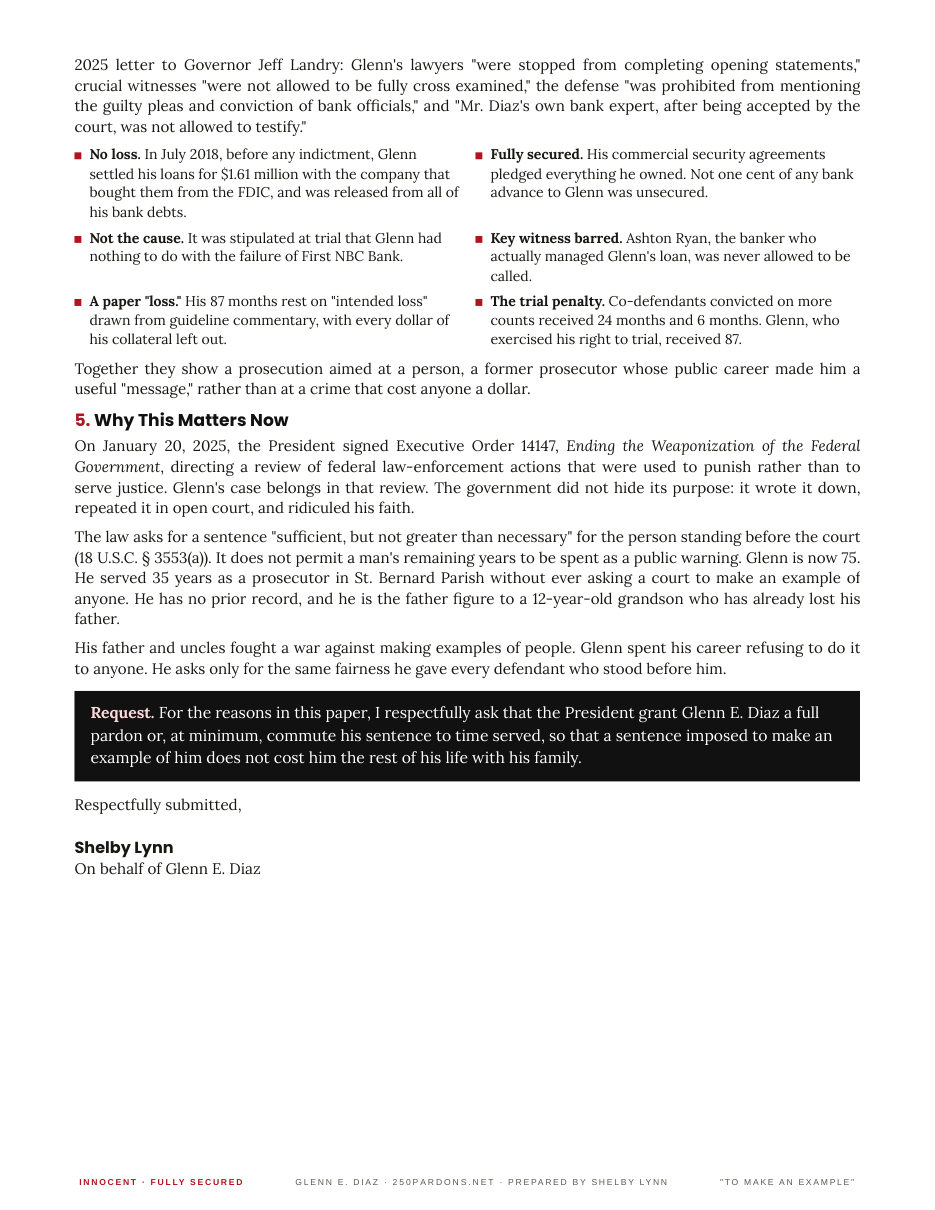
How can someone with a commercial security agreement that pledged his substantial assets, far above any monies received, commit fraud?
Glenn E. Diaz
PREPARED BY
Shelby Lynn
Age 75 · 35-year prosecutor · No prior record · 50 years of finances audited,
ON BEHALF OF GLENN E.
nothing found
DIAZ
INNOCENT. FULLY SECURED. WRONGLY PROSECUTED.
87 MONTHS FOR A 75-YEAR-OLD MAN WHOSE BANK COULD NOT LOSE A DOLLAR
Page 2
THE QUESTION
He couldn't. Glenn Diaz is innocent.
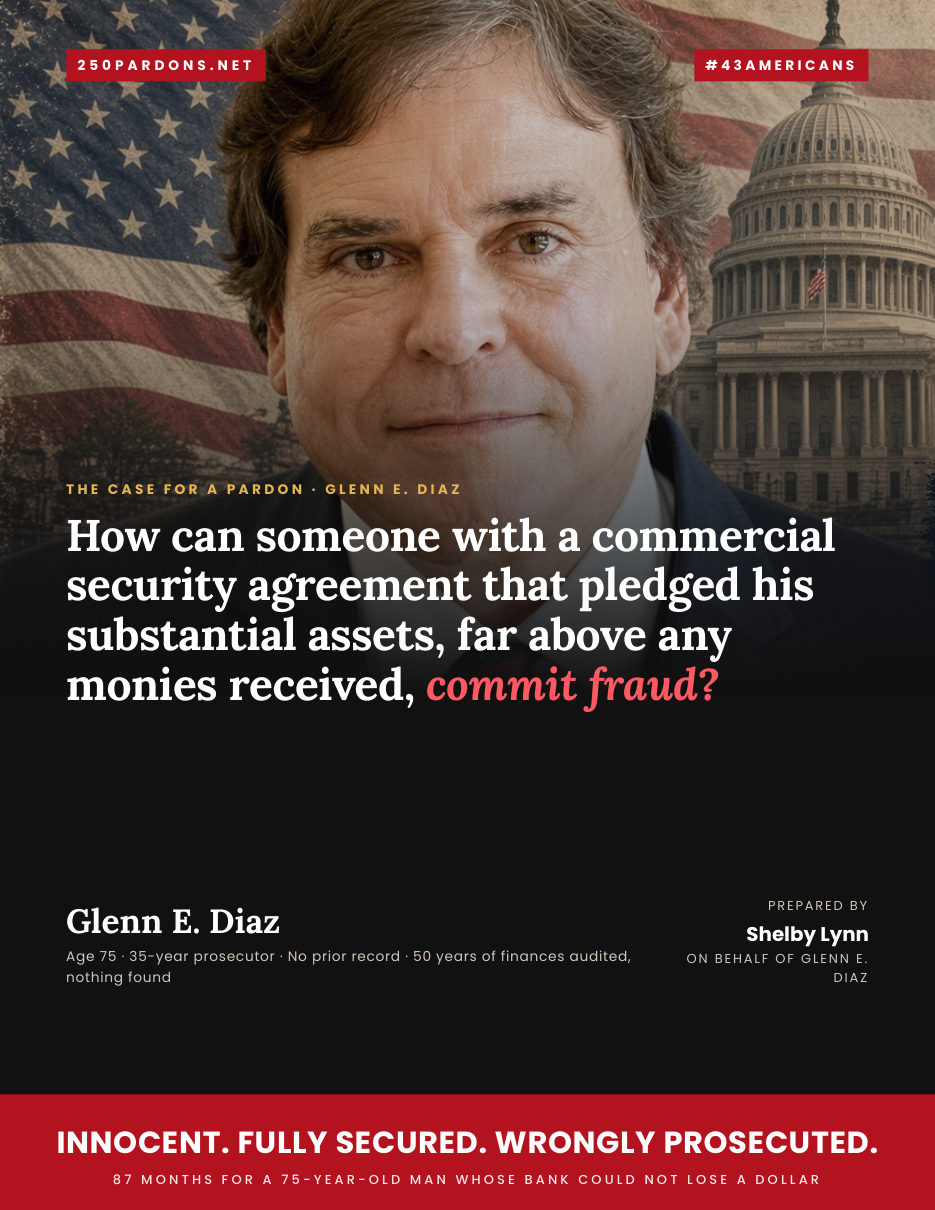
Glenn Diaz borrowed on a revolving line of credit, in his own name, approved by the bank on the strength of his collateral, and secured by a master note and commercial security agreement that made everything he owned available to the bank. The bank was never exposed to a single dollar of loss. The government's own forensic accountant combed through his finances all the way back to 1975 and found nothing. Yet Glenn, a 75-year-old retired prosecutor with no criminal record, is serving 87 months in federal prison.
I prepared this case summary on behalf of Glenn Diaz because I believe he is innocent, and because I believe the government used its enormous power against the wrong man. When I began reviewing his case, one question kept coming back to me, the question on the front of this document. Fraud requires deception that puts someone's money at risk. First NBC Bank held a security interest in every asset Glenn owned, worth far more than anything he ever drew. There was no risk, and there was no victim.
The government did not stop there. It sent a forensic accountant through nearly fifty years of Glenn's financial life, back to 1975. That review turned up nothing but a few audits that ended with no change. In July 2018, before any indictment, Glenn settled his loans with the company that bought them from the FDIC, paying $1.61 million, and was released from his personal obligation. What the government found instead was a 35-year public servant with clean books, a fully secured loan, and no criminal history, and it prosecuted him anyway.
Innocent. Fully secured. Wrongly prosecuted.
A pardon for Glenn E. Diaz.
Shelby Lynn
PREPARED ON BEHALF OF GLENN E. DIAZ · FOR
250PARDONS.NET
· OCTOBER 2026
View page 2 as designed (charts and tables)
Page 3
AT A GLANCE
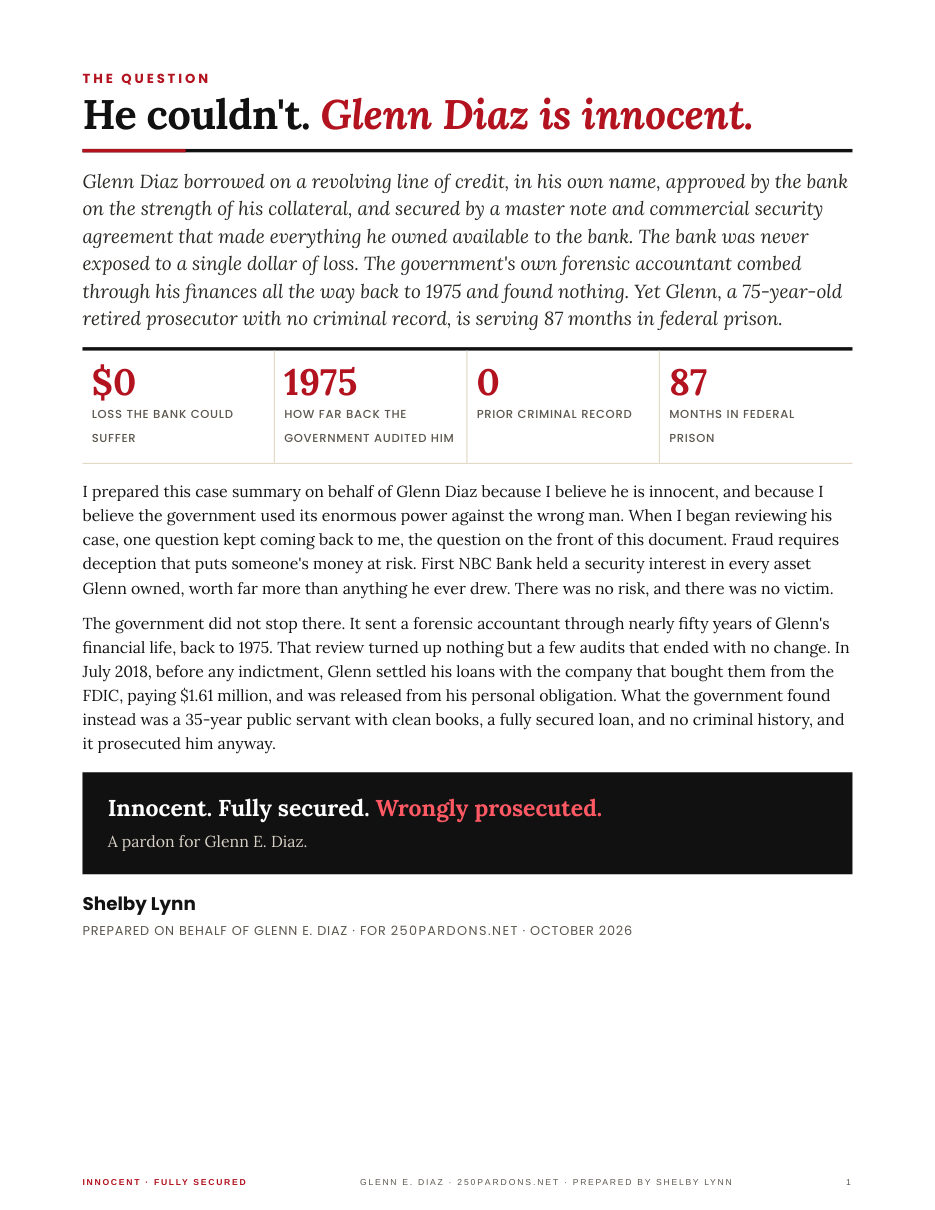
Nine reasons Glenn Diaz is innocent and should be pardoned
The bank could not lose
A commercial security agreement pledged all of Glenn's substantial assets, far above any money he received. There was never an unsecured dollar, and there was never a loss.
Fifty years of clean books
The government's forensic accountant reviewed his finances back to 1975 and found nothing but a few audits that ended with no change. Before any indictment, his loans were settled and his obligation released.
Nothing was hidden
The credit was in his own name and Social Security number. The bank's own officer told federal investigators the bank's president did not require Glenn to use his First NBC account.
Estimates, not invoices
The documents the government called fake invoices were contractor estimates for roof and sprinkler repairs to a vacant building.
The jury rejected most of the case
Of 31 counts, jurors could not agree on 21. The government's case against him largely failed.
The argument the court cut off
At sentencing, his lawyer was interrupted mid-sentence while explaining that the master note made all of Glenn's assets security. The argument was never finished, and Glenn was denied the chance to respond.
Sentenced on a loss that never happened
His 87 months rest on "intended loss," a concept that came from guideline commentary that the Third Circuit has held courts may not use. His pledged collateral was never credited against it.
Punished for going to trial
His co-defendants, convicted on more counts, received 24 months and 6 months. Glenn, who maintained his innocence, received 87.
A lifetime of service
Thirty-five years prosecuting felonies for St. Bernard Parish, and a hero of Hurricane Katrina.
View page 3 as designed (charts and tables)
Page 4
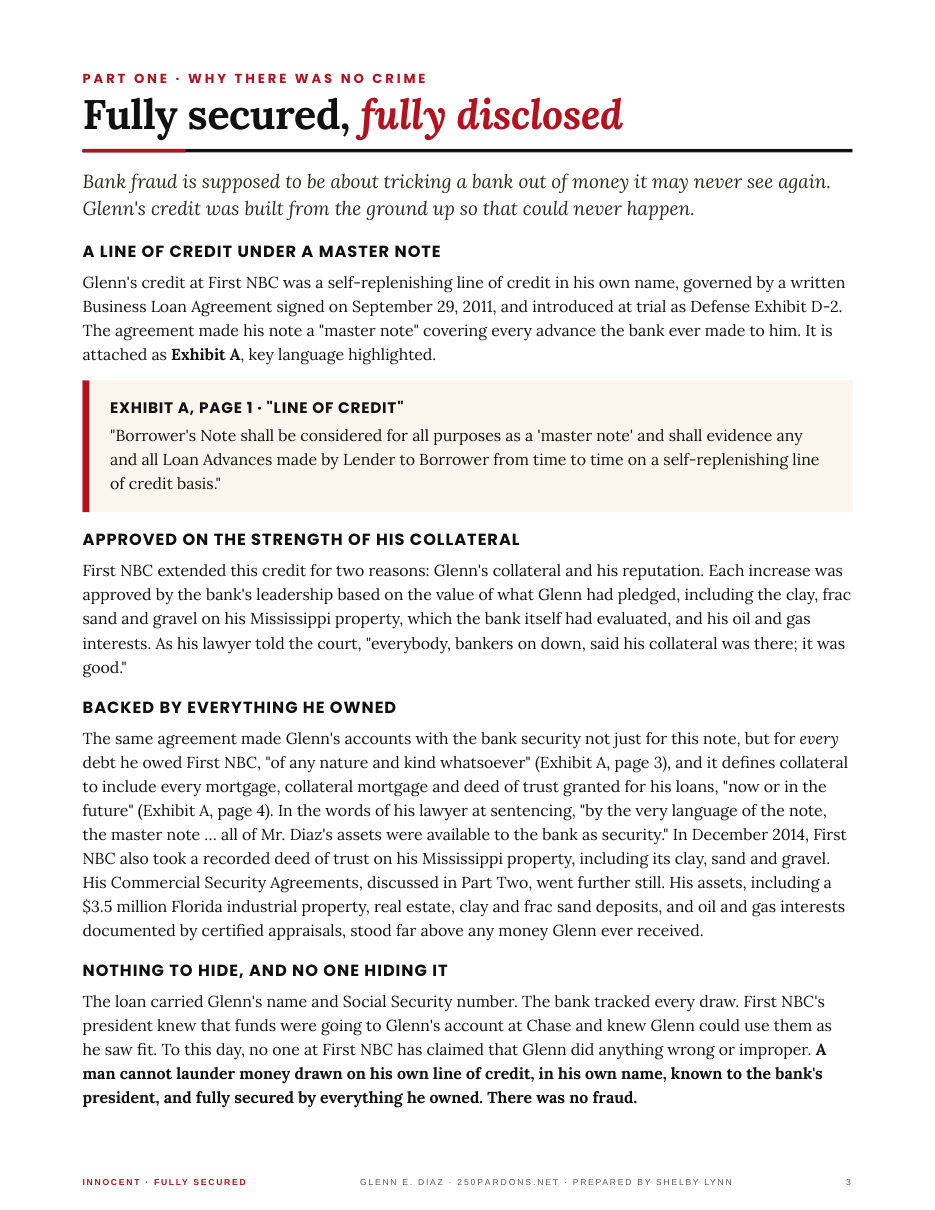
PART ONE · WHY THERE WAS NO CRIME
Fully secured, fully disclosed
Bank fraud is supposed to be about tricking a bank out of money it may never see again. Glenn's credit was built from the ground up so that could never happen.
A LINE OF CREDIT UNDER A MASTER NOTE
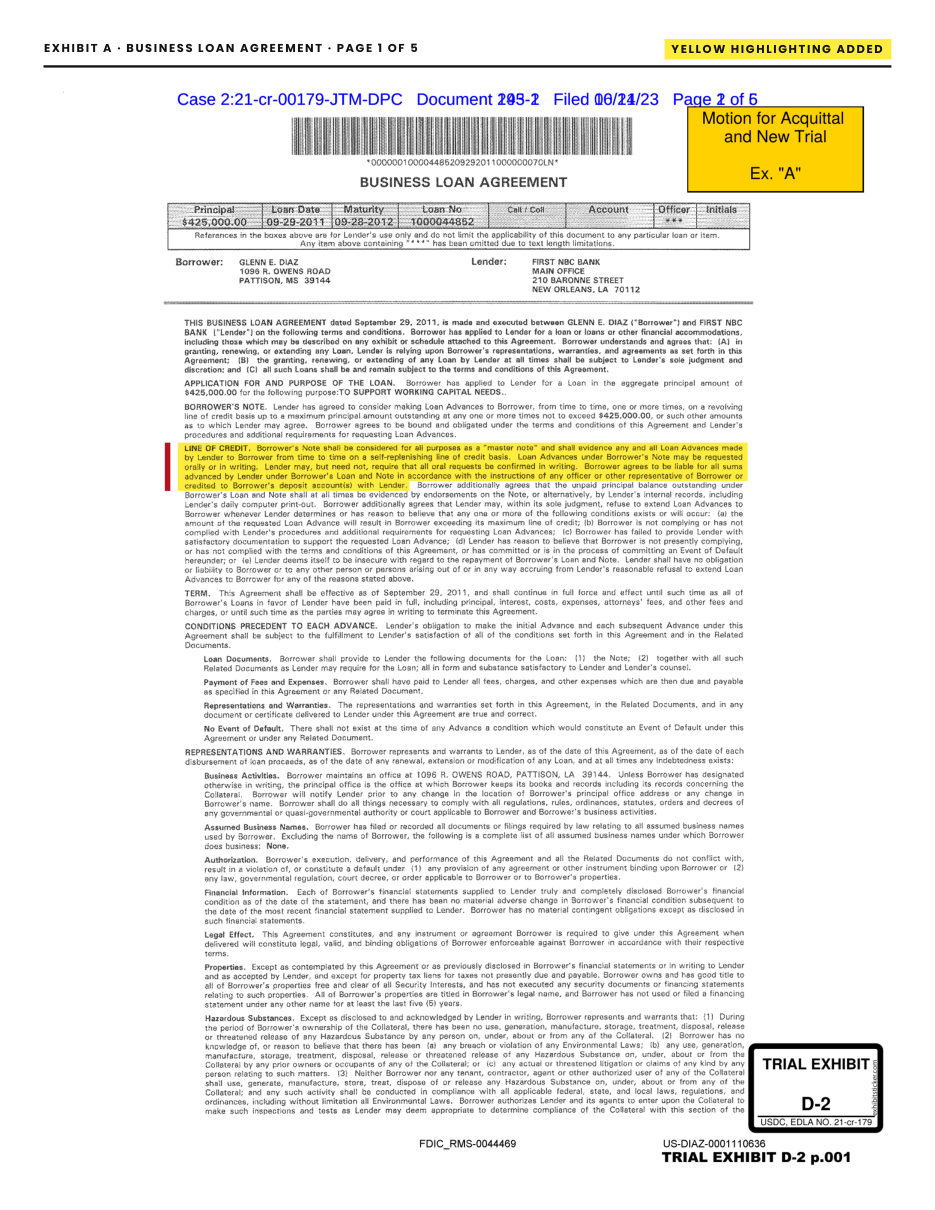
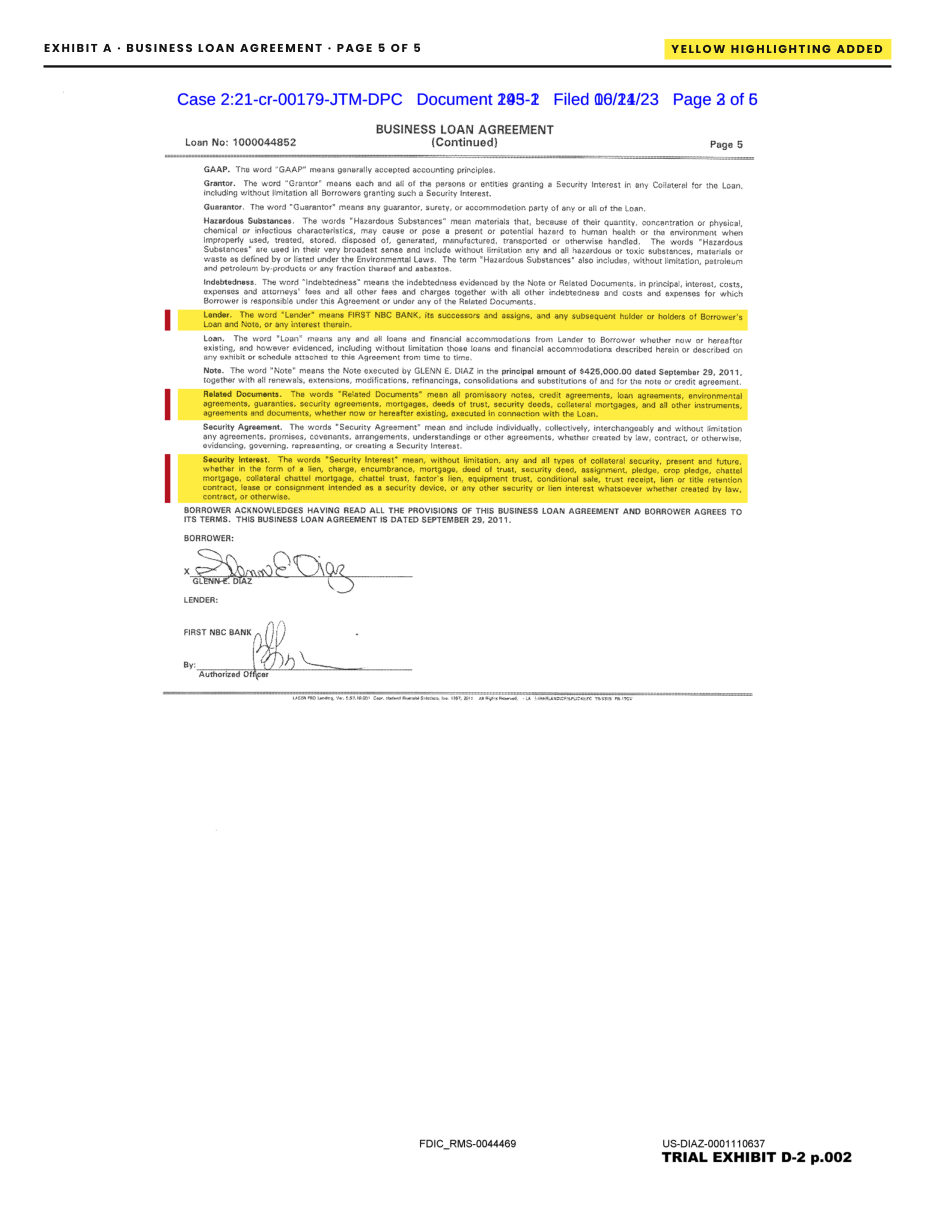
Glenn's credit at First NBC was a self-replenishing line of credit in his own name, governed by a written Business Loan Agreement signed on September 29, 2011, and introduced at trial as Defense Exhibit D-2. The agreement made his note a "master note" covering every advance the bank ever made to him. It is attached as Exhibit A, key language highlighted.
EXHIBIT A, PAGE 1 · "LINE OF CREDIT"
"Borrower's Note shall be considered for all purposes as a 'master note' and shall evidence any and all Loan Advances made by Lender to Borrower from time to time on a self-replenishing line of credit basis."
APPROVED ON THE STRENGTH OF HIS COLLATERAL
First NBC extended this credit for two reasons: Glenn's collateral and his reputation. Each increase was approved by the bank's leadership based on the value of what Glenn had pledged, including the clay, frac sand and gravel on his Mississippi property, which the bank itself had evaluated, and his oil and gas interests. As his lawyer told the court, "everybody, bankers on down, said his collateral was there; it was good."
BACKED BY EVERYTHING HE OWNED
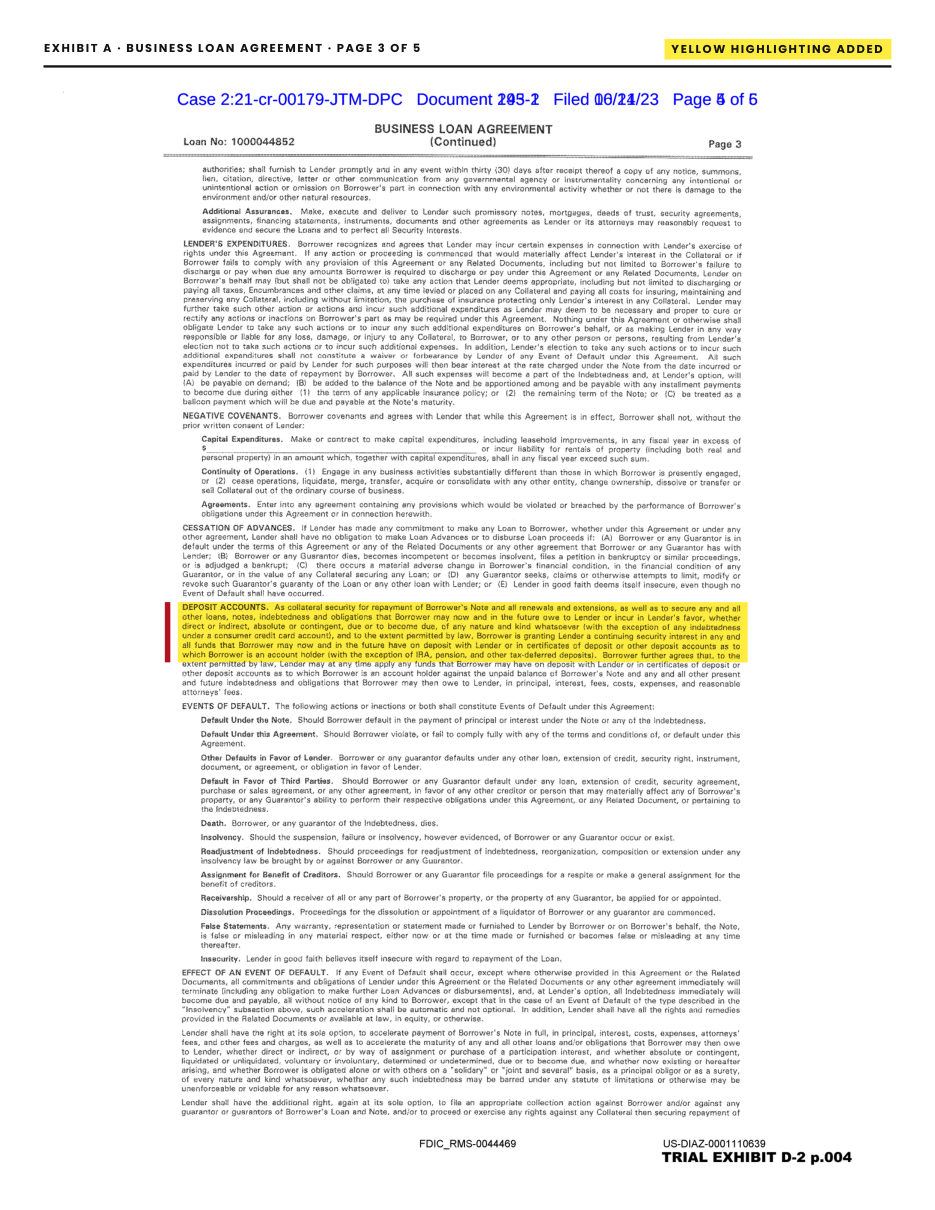
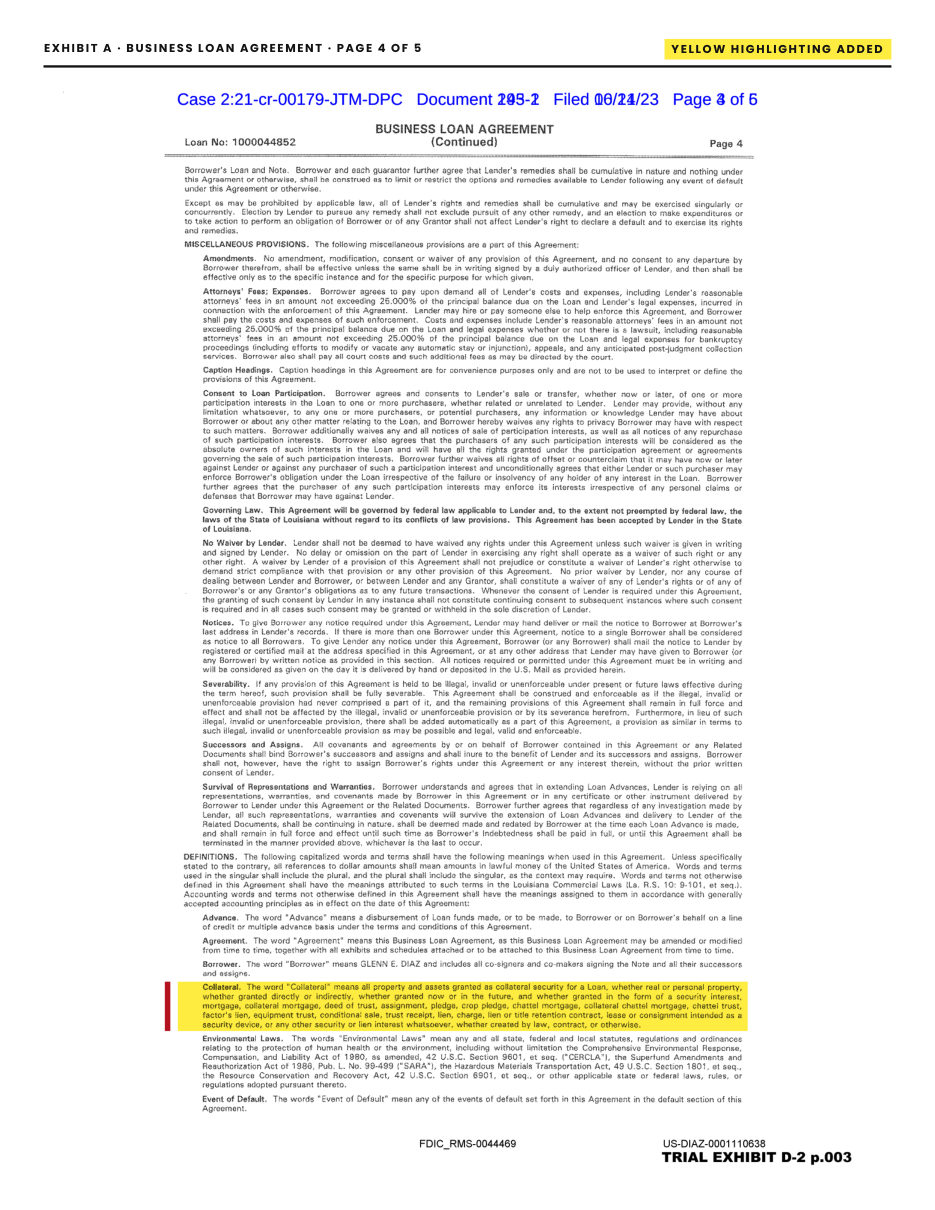
The same agreement made Glenn's accounts with the bank security not just for this note, but for every debt he owed First NBC, "of any nature and kind whatsoever" (Exhibit A, page 3), and it defines collateral to include every mortgage, collateral mortgage and deed of trust granted for his loans, "now or in the future" (Exhibit A, page 4). In the words of his lawyer at sentencing, "by the very language of the note, the master note … all of Mr. Diaz's assets were available to the bank as security." In December 2014, First NBC also took a recorded deed of trust on his Mississippi property, including its clay, sand and gravel. His Commercial Security Agreements, discussed in Part Two, went further still. His assets, including a $3.5 million Florida industrial property, real estate, clay and frac sand deposits, and oil and gas interests documented by certified appraisals, stood far above any money Glenn ever received.
NOTHING TO HIDE, AND NO ONE HIDING IT
The loan carried Glenn's name and Social Security number. The bank tracked every draw. First NBC's president knew that funds were going to Glenn's account at Chase and knew Glenn could use them as he saw fit. To this day, no one at First NBC has claimed that Glenn did anything wrong or improper. A man cannot launder money drawn on his own line of credit, in his own name, known to the bank's president, and fully secured by everything he owned. There was no fraud.
View page 4 as designed (charts and tables)
Page 5
PART TWO · THE PROOF IN THE COURT RECORD
Everything he owned, on paper and under oath
Glenn has always said he signed an agreement that made everything he owned security for the bank. The court record proves it.
THE COMMERCIAL SECURITY AGREEMENTS
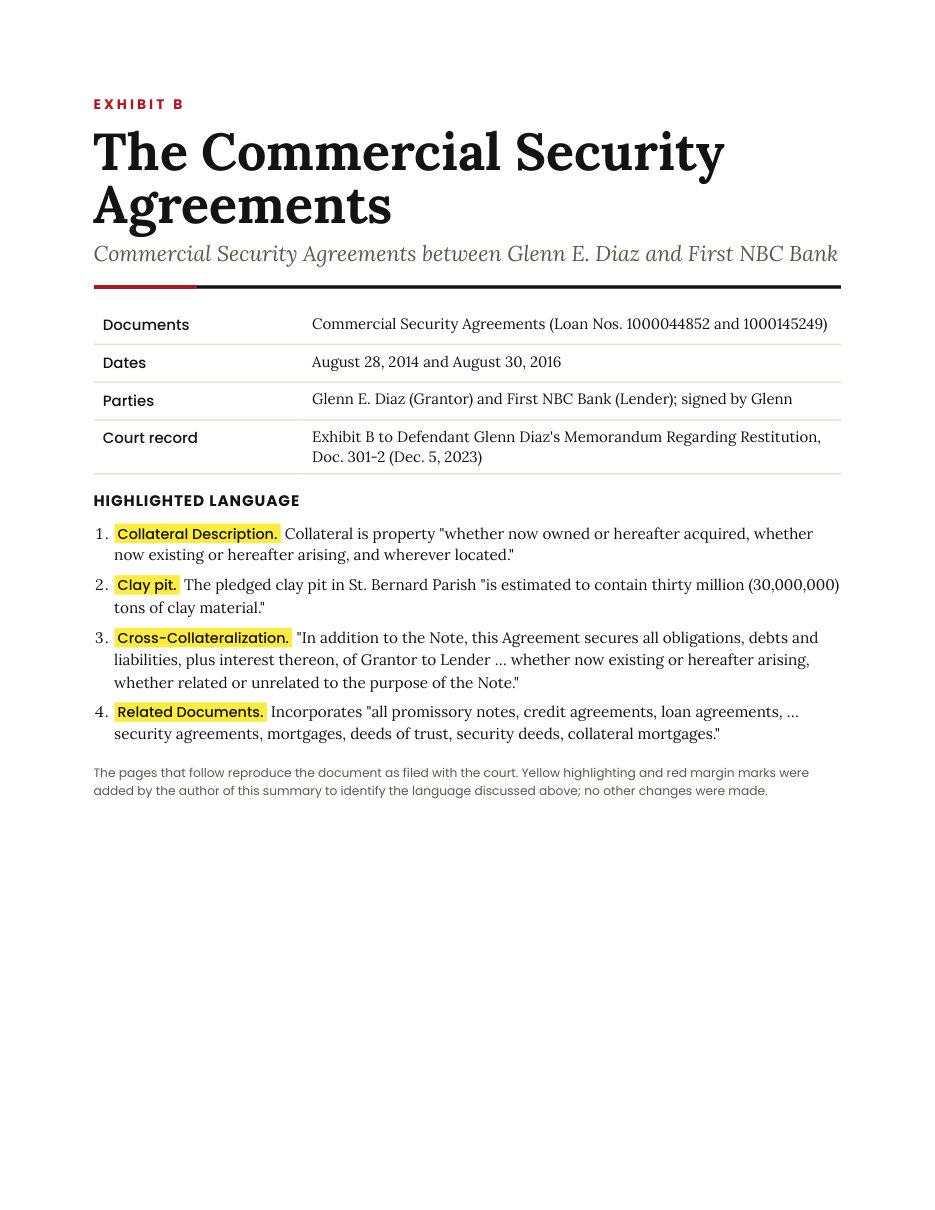
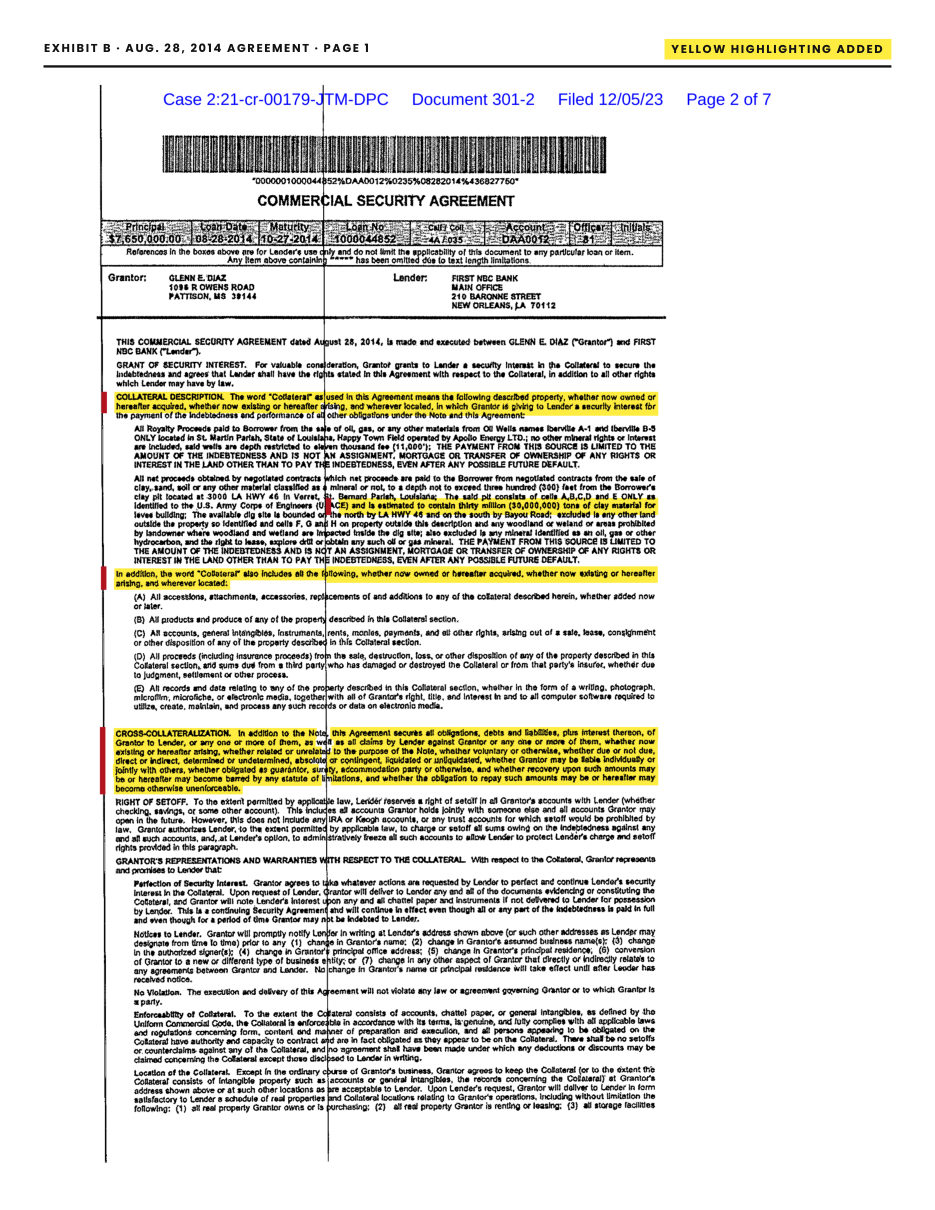
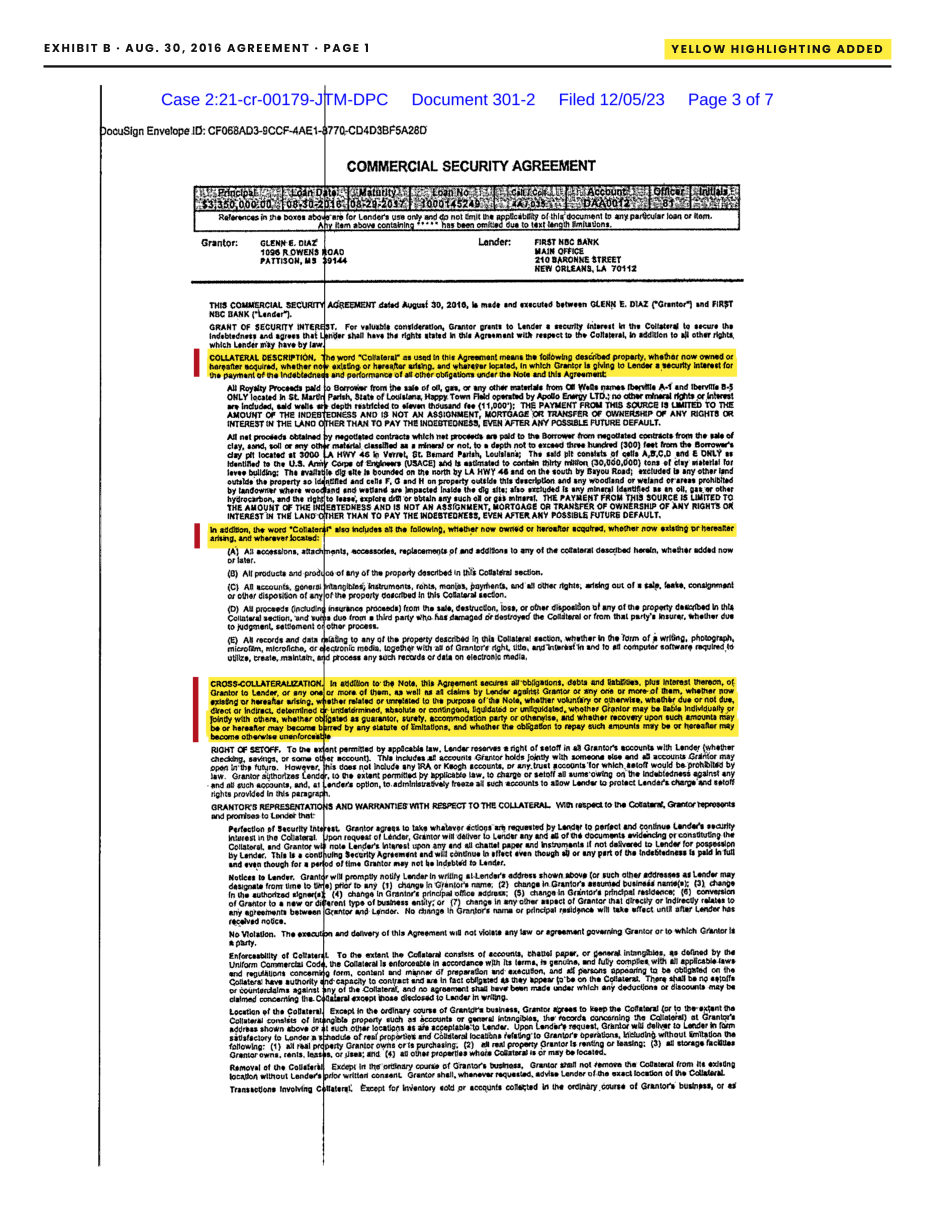
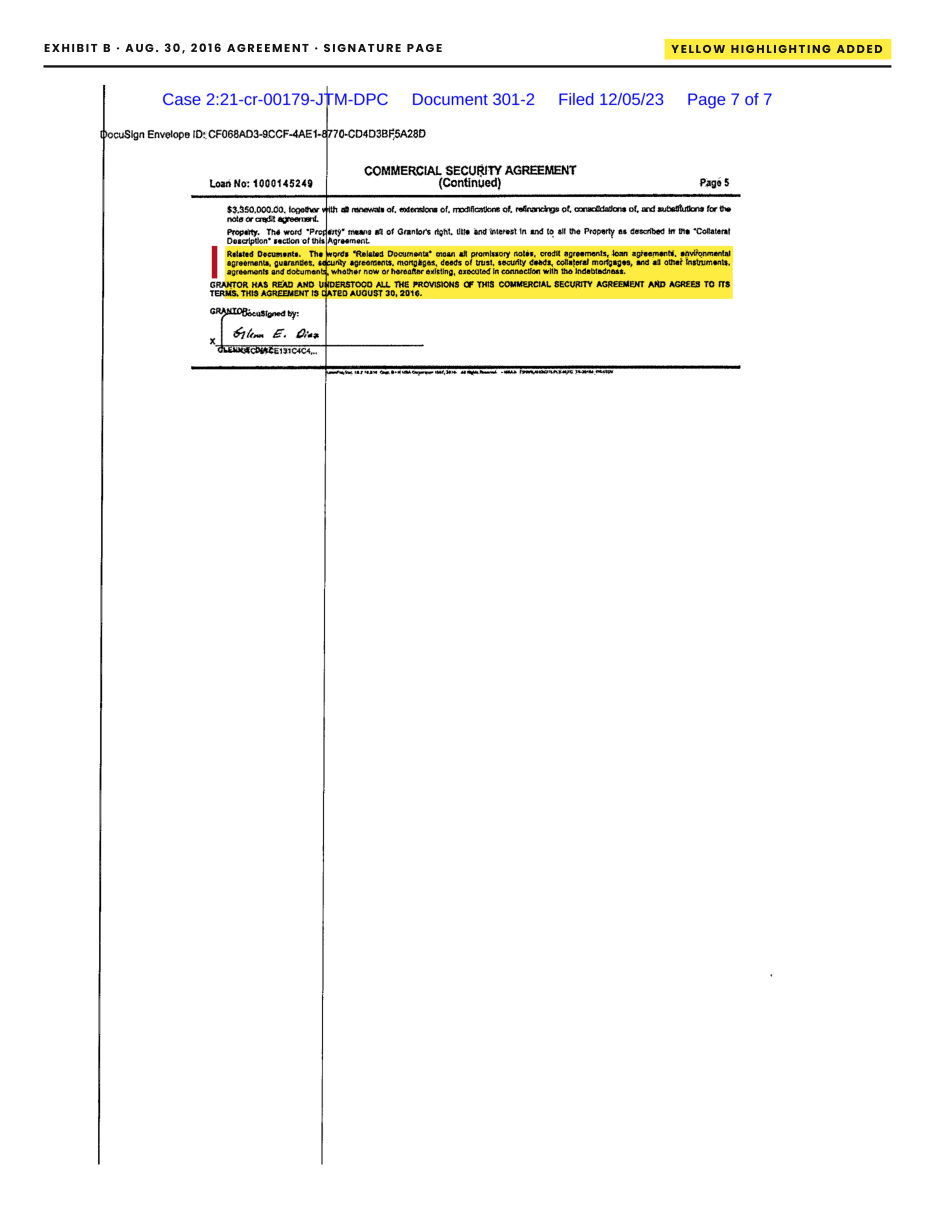
Glenn signed Commercial Security Agreements with First NBC on August 28, 2014 and August 30, 2016. Each covers property "whether now owned or hereafter acquired," and each contains this clause (Exhibit B):
"In addition to the Note, this Agreement secures all obligations, debts and liabilities, plus interest thereon, of Grantor to Lender, … whether now existing or hereafter arising, whether related or unrelated to the purpose of the Note."
As Glenn's lawyers told the court, "the plain language of this Agreement puts all of Diaz's assets at the disposal of the bank." First NBC also held second mortgages on the Florida property and his Mississippi land and timber, and a lien on his St. Bernard clay land, estimated to hold 30 million tons of clay. By the time of trial, that clay had already produced revenue well in excess of the money owed to the bank, proof that Glenn's means of repayment was real, not hypothetical or conjecture.
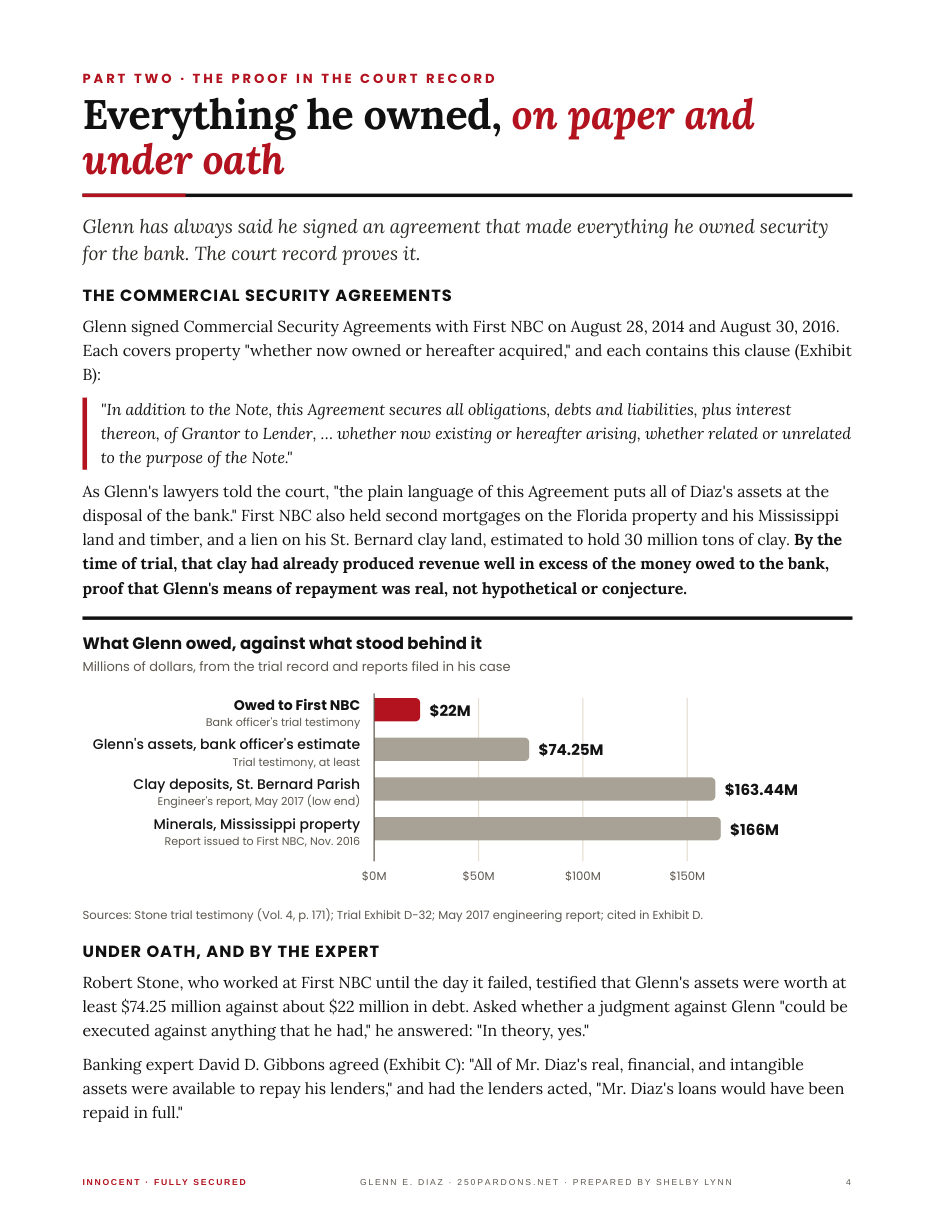
What Glenn owed, against what stood behind it
Millions of dollars, from the trial record and reports filed in his case
Owed to First NBC
$22M
Bank officer's trial testimony
Glenn's assets, bank officer's estimate
$74.25M
Trial testimony, at least
Clay deposits, St. Bernard Parish
$163.44M
Engineer's report, May 2017 (low end)
Minerals, Mississippi property
$166M
Report issued to First NBC, Nov. 2016
$0M
$50M
$100M
$150M
Sources: Stone trial testimony (Vol. 4, p. 171); Trial Exhibit D-32; May 2017 engineering report; cited in Exhibit D.
UNDER OATH, AND BY THE EXPERT
Robert Stone, who worked at First NBC until the day it failed, testified that Glenn's assets were worth at least $74.25 million against about $22 million in debt. Asked whether a judgment against Glenn "could be executed against anything that he had," he answered: "In theory, yes."
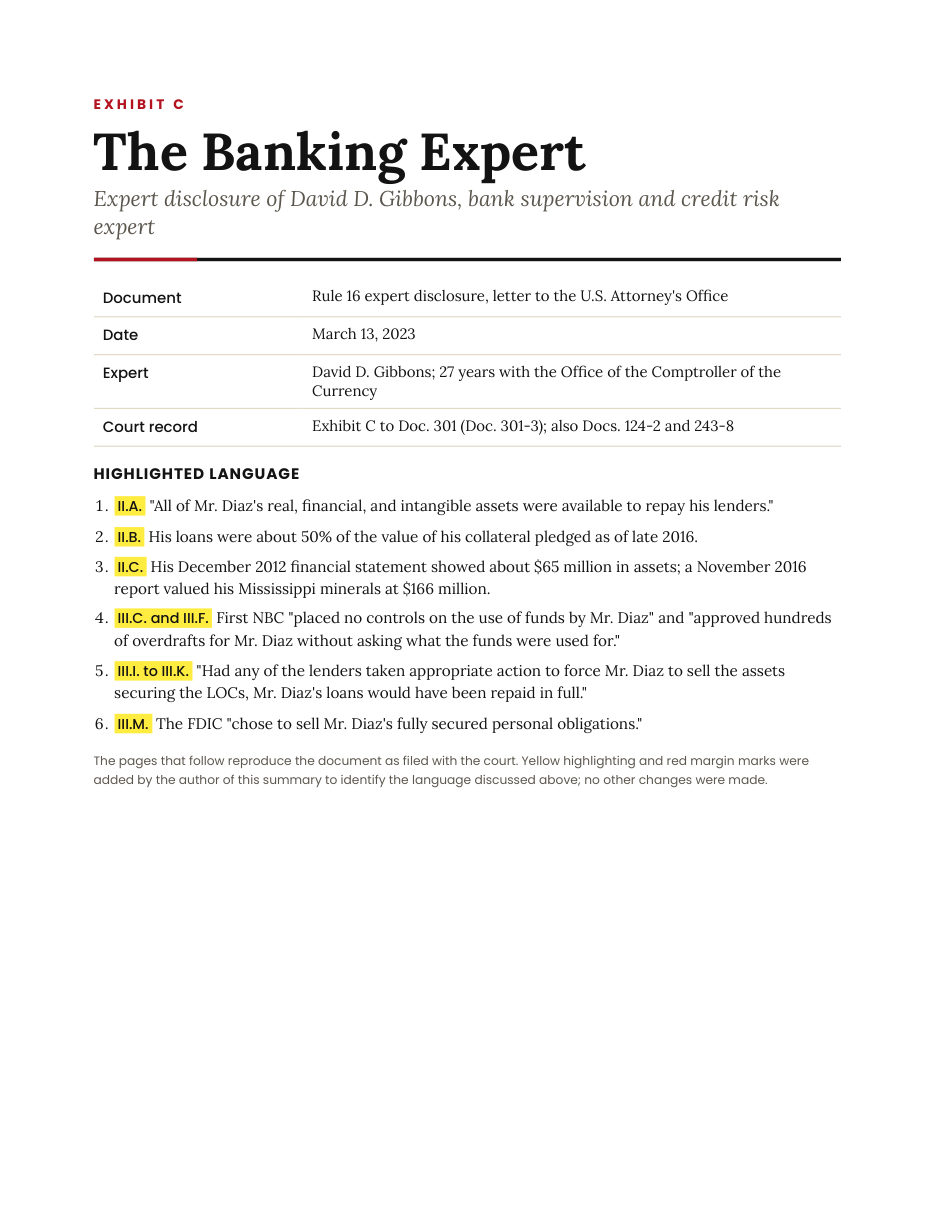
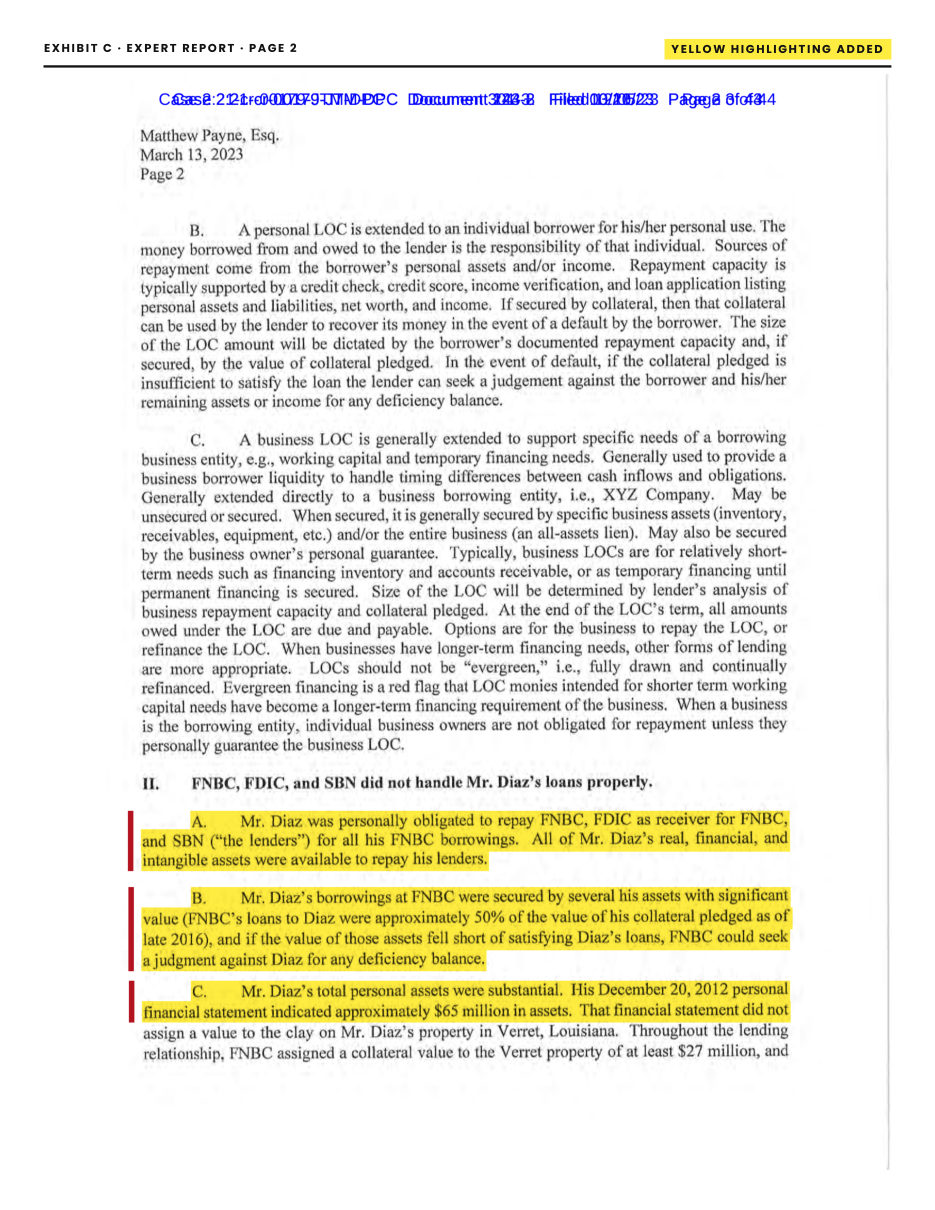
Banking expert David D. Gibbons agreed (Exhibit C): "All of Mr. Diaz's real, financial, and intangible assets were available to repay his lenders," and had the lenders acted, "Mr. Diaz's loans would have been repaid in full."
View page 5 as designed (charts and tables)
Page 6
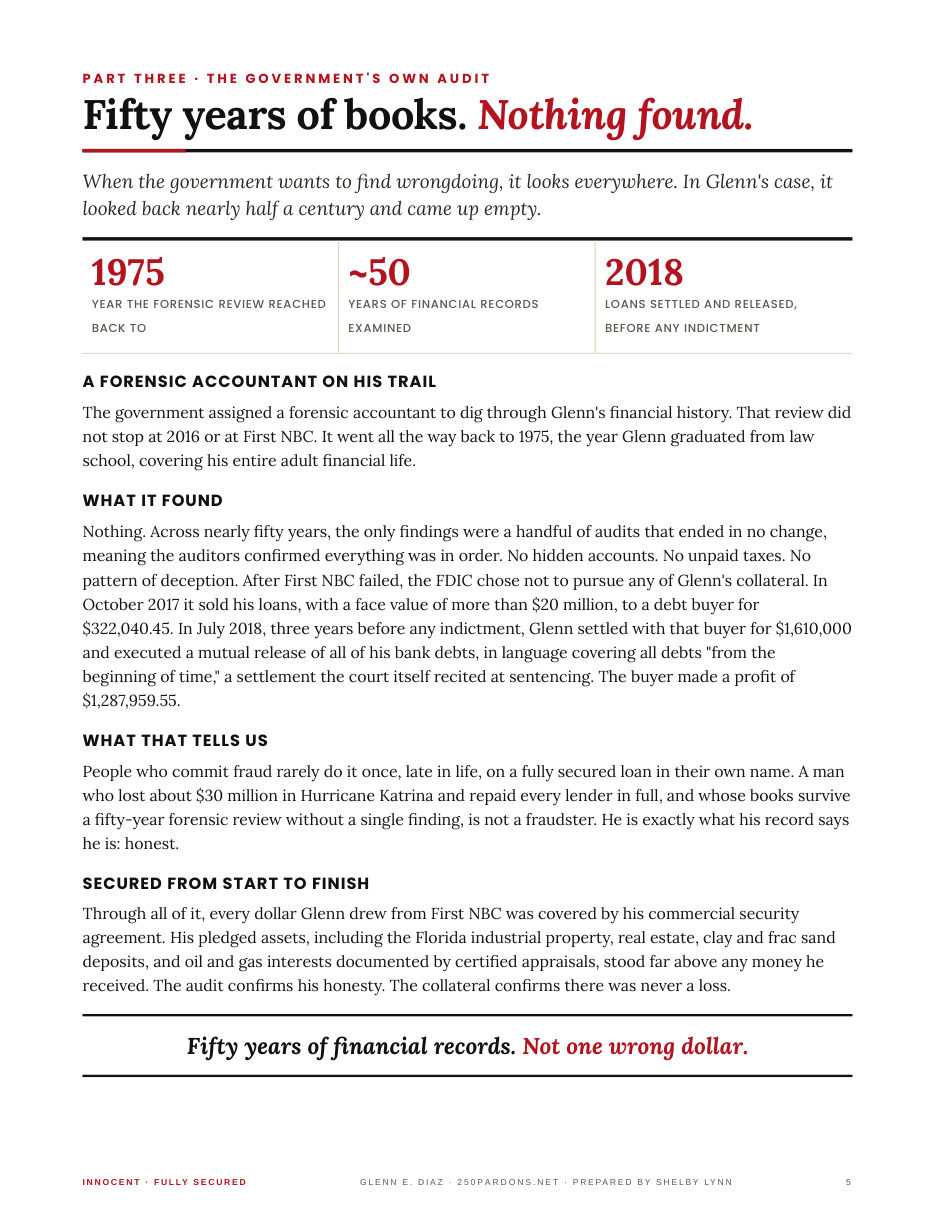
PART THREE · THE GOVERNMENT'S OWN AUDIT
Fifty years of books. Nothing found.
When the government wants to find wrongdoing, it looks everywhere. In Glenn's case, it looked back nearly half a century and came up empty.
A FORENSIC ACCOUNTANT ON HIS TRAIL
The government assigned a forensic accountant to dig through Glenn's financial history. That review did not stop at 2016 or at First NBC. It went all the way back to 1975, the year Glenn graduated from law school, covering his entire adult financial life.
WHAT IT FOUND
Nothing. Across nearly fifty years, the only findings were a handful of audits that ended in no change, meaning the auditors confirmed everything was in order. No hidden accounts. No unpaid taxes. No pattern of deception. After First NBC failed, the FDIC chose not to pursue any of Glenn's collateral. In October 2017 it sold his loans, with a face value of more than $20 million, to a debt buyer for $322,040.45. In July 2018, three years before any indictment, Glenn settled with that buyer for $1,610,000 and executed a mutual release of all of his bank debts, in language covering all debts "from the beginning of time," a settlement the court itself recited at sentencing. The buyer made a profit of $1,287,959.55.
WHAT THAT TELLS US
People who commit fraud rarely do it once, late in life, on a fully secured loan in their own name. A man who lost about $30 million in Hurricane Katrina and repaid every lender in full, and whose books survive a fifty-year forensic review without a single finding, is not a fraudster. He is exactly what his record says he is: honest.
SECURED FROM START TO FINISH
Through all of it, every dollar Glenn drew from First NBC was covered by his commercial security agreement. His pledged assets, including the Florida industrial property, real estate, clay and frac sand deposits, and oil and gas interests documented by certified appraisals, stood far above any money he received. The audit confirms his honesty. The collateral confirms there was never a loss.
Fifty years of financial records. Not one wrong dollar.
View page 6 as designed (charts and tables)
Page 7
PART FOUR · THE MAN
Thirty-five years on the people's side
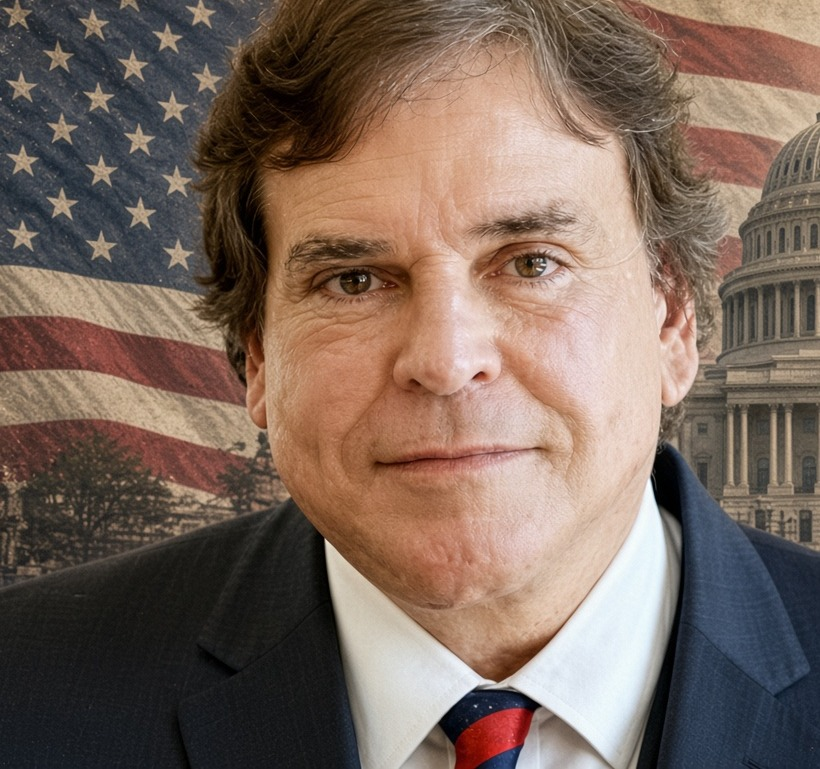
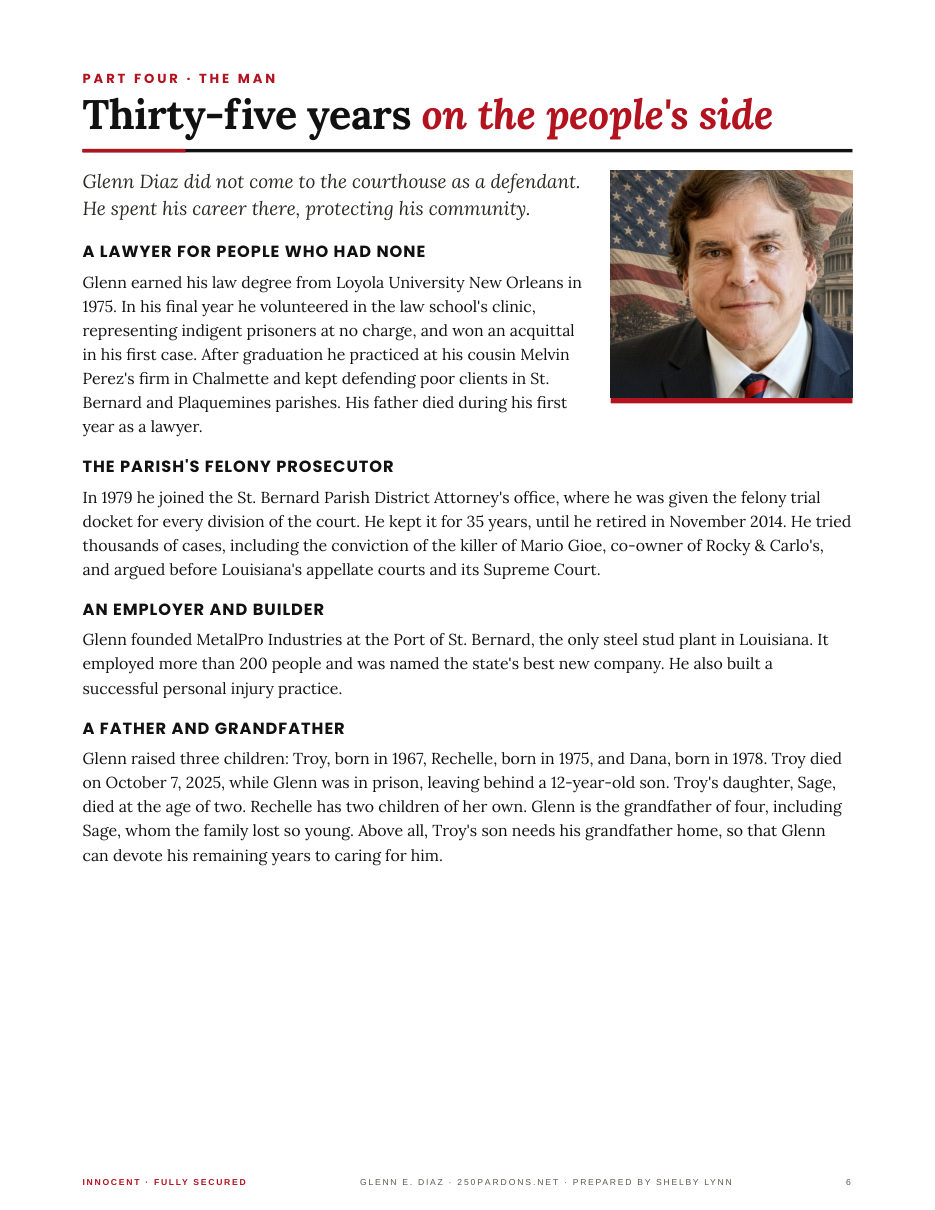
Glenn Diaz did not come to the courthouse as a defendant. He spent his career there, protecting his community.
A LAWYER FOR PEOPLE WHO HAD NONE
Glenn earned his law degree from Loyola University New Orleans in 1975. In his final year he volunteered in the law school's clinic, representing indigent prisoners at no charge, and won an acquittal in his first case. After graduation he practiced at his cousin Melvin Perez's firm in Chalmette and kept defending poor clients in St. Bernard and Plaquemines parishes. His father died during his first year as a lawyer.
THE PARISH'S FELONY PROSECUTOR
In 1979 he joined the St. Bernard Parish District Attorney's office, where he was given the felony trial docket for every division of the court. He kept it for 35 years, until he retired in November 2014. He tried thousands of cases, including the conviction of the killer of Mario Gioe, co-owner of Rocky & Carlo's, and argued before Louisiana's appellate courts and its Supreme Court.
AN EMPLOYER AND BUILDER
Glenn founded MetalPro Industries at the Port of St. Bernard, the only steel stud plant in Louisiana. It employed more than 200 people and was named the state's best new company. He also built a successful personal injury practice.
A FATHER AND GRANDFATHER
Glenn raised three children: Troy, born in 1967, Rechelle, born in 1975, and Dana, born in 1978. Troy died on October 7, 2025, while Glenn was in prison, leaving behind a 12-year-old son. Troy's daughter, Sage, died at the age of two. Rechelle has two children of her own. Glenn is the grandfather of four, including Sage, whom the family lost so young. Above all, Troy's son needs his grandfather home, so that Glenn can devote his remaining years to caring for him.
View page 7 as designed (charts and tables)
Page 8
PART FIVE · THE STORM
He stayed. He rescued. He repaid.
Hurricane Katrina showed exactly who Glenn Diaz is, long before anyone accused him of anything.
TWENTY-TWO FEET OF WATER
When Katrina hit in August 2005, Glenn was home in Meraux, at the center of the devastation in St. Bernard Parish. He chose not to leave. As the water rose to 22 feet in his street, he pulled his neighbors off their roofs and ferried nursing home residents by boat to high ground near his steel factory, where they could be evacuated.
LOSING NEARLY EVERYTHING
The storm cost him about $30 million. His factory, its contracts, including a deal to build 1,600 homes that week, his house, and his law practice were all lost. He received no Road Home assistance.
KEEPING THE COURTS OPEN
Glenn lived at his property in Pattison, Mississippi, and drove three hours each way to St. Bernard, where the damaged courthouse ran out of an annex. He kept the felony docket moving for the people of the parish.
PAYING BACK EVERY DOLLAR
Glenn did not walk away from his debts. MetalPro's insurance went to the lenders. He sold the factory, his oil well and oil property, and his clay pits. He kept a $15–20 million Whitney Bank loan current through the storm and never in default. By 2008, Whitney, First Bank and Trust, and First NBC had all been paid in full.
A man who lost $30 million and repaid every lender in full is not a man who sets out to cheat a bank.
View page 8 as designed (charts and tables)
Page 9
PART SIX · WHAT REALLY HAPPENED
A building on high ground, and a bank that broke its word
REBUILDING METALPRO
In 2006 Glenn bought a 150,000-square-foot industrial building on 35 acres in Florida for about $3.5 million. Above sea level, with rail and water access, it was meant to be the new MetalPro. He placed it in his children's names so they would benefit from the rebuilt business without carrying its liability, with First NBC's full knowledge and his children's blessing. He leased the building to Trane on a triple-net lease, which covered the taxes, the utilities and the mortgage note.
2016: A VACANT BUILDING
By 2016 Trane had moved out. The roof needed repair and the sprinkler system needed to be redone. Trustmark held the first mortgage on the property, and First NBC had promised Glenn it would pay that mortgage. It did not. Glenn understandably asked why he should pay to fix the roof of a building whose first mortgage the bank had left unpaid.
ESTIMATES, NEVER INVOICES
Glenn hired a contractor for the roof and sprinklers and planned to add labor through Labor Ready. The contractor provided estimates of the work to be done. They were estimates of future work, not invoices for finished work. That difference was never made clear to the jury, and it is the difference between innocence and guilt.
STORMS AND A BREAK-IN
While the work was under way, storms damaged the building, and thieves broke in and stripped its copper and wiring. They were later convicted and sentenced.
THE MONEY CAME HOME
With the construction stalled, the money came back to Glenn, less about $14,000 the contractor kept. Glenn held it at Chase, because First NBC would have swept any deposit to pay the note, leaving nothing for repairs. The bank's president knew. The bank's money was never at risk: every dollar remained secured by Glenn's commercial security agreement and his substantial assets.
NOT CONVICTED ON THE CONTRACTOR'S TRANSACTIONS
The government built much of its story around the contractor's estimates and the checks that came back. Yet Glenn was not convicted on any of the substantive counts involving the contractor's transactions.
View page 9 as designed (charts and tables)
Page 10
PART SEVEN · THE PROSECUTION
The bank's CEO wrecked it. The customer got half his sentence.
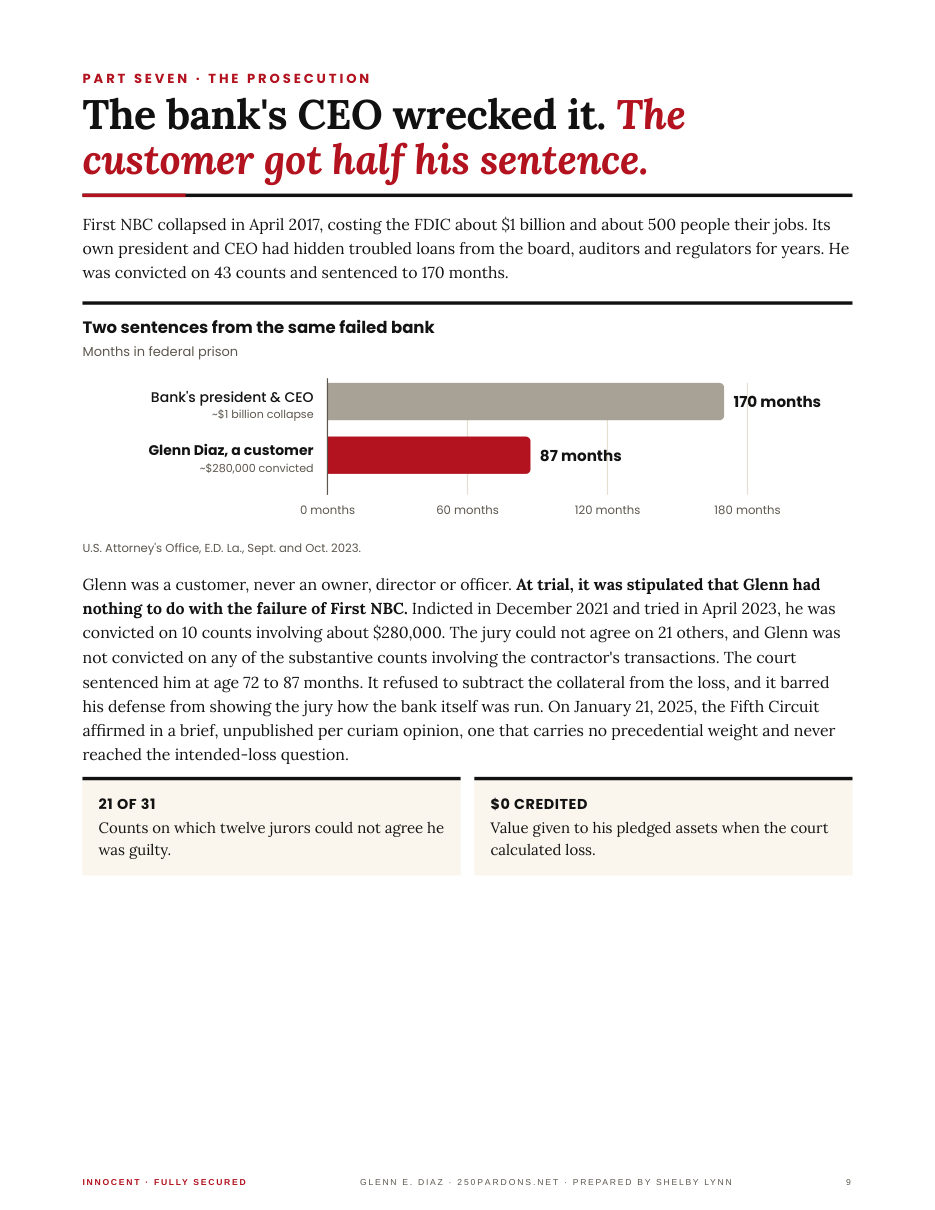
First NBC collapsed in April 2017, costing the FDIC about $1 billion and about 500 people their jobs. Its own president and CEO had hidden troubled loans from the board, auditors and regulators for years. He was convicted on 43 counts and sentenced to 170 months.
Two sentences from the same failed bank
Months in federal prison
Bank's president & CEO
170 months
~$1 billion collapse
Glenn Diaz, a customer
87 months
~$280,000 convicted
0 months
60 months
120 months
180 months
U.S. Attorney's Office, E.D. La., Sept. and Oct. 2023.
Glenn was a customer, never an owner, director or officer. At trial, it was stipulated that Glenn had nothing to do with the failure of First NBC. Indicted in December 2021 and tried in April 2023, he was convicted on 10 counts involving about $280,000. The jury could not agree on 21 others, and Glenn was not convicted on any of the substantive counts involving the contractor's transactions. The court sentenced him at age 72 to 87 months. It refused to subtract the collateral from the loss, and it barred his defense from showing the jury how the bank itself was run. On January 21, 2025, the Fifth Circuit affirmed in a brief, unpublished per curiam opinion, one that carries no precedential weight and never reached the intended-loss question.
21 OF 31
$0 CREDITED
Counts on which twelve jurors could not agree he
Value given to his pledged assets when the court
was guilty.
calculated loss.
View page 10 as designed (charts and tables)
Page 11
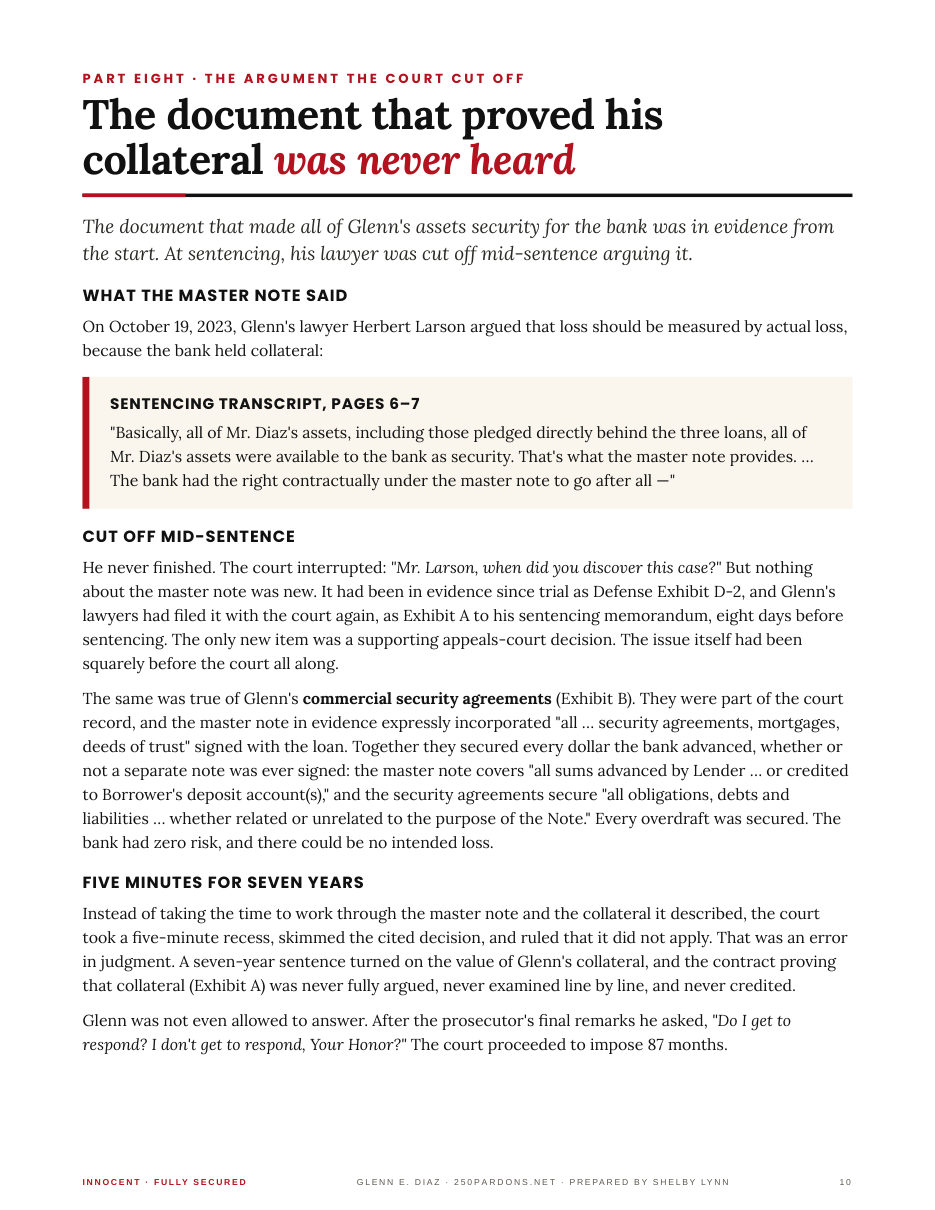
PART EIGHT · THE ARGUMENT THE COURT CUT OFF
The document that proved his collateral was never heard
The document that made all of Glenn's assets security for the bank was in evidence from the start. At sentencing, his lawyer was cut off mid-sentence arguing it.
WHAT THE MASTER NOTE SAID
On October 19, 2023, Glenn's lawyer Herbert Larson argued that loss should be measured by actual loss, because the bank held collateral:
SENTENCING TRANSCRIPT, PAGES 6–7
"Basically, all of Mr. Diaz's assets, including those pledged directly behind the three loans, all of Mr. Diaz's assets were available to the bank as security. That's what the master note provides. … The bank had the right contractually under the master note to go after all —"
CUT OFF MID-SENTENCE
He never finished. The court interrupted: "Mr. Larson, when did you discover this case?" But nothing about the master note was new. It had been in evidence since trial as Defense Exhibit D-2, and Glenn's lawyers had filed it with the court again, as Exhibit A to his sentencing memorandum, eight days before sentencing. The only new item was a supporting appeals-court decision. The issue itself had been squarely before the court all along.
The same was true of Glenn's commercial security agreements (Exhibit B). They were part of the court record, and the master note in evidence expressly incorporated "all … security agreements, mortgages, deeds of trust" signed with the loan. Together they secured every dollar the bank advanced, whether or not a separate note was ever signed: the master note covers "all sums advanced by Lender … or credited to Borrower's deposit account(s)," and the security agreements secure "all obligations, debts and liabilities … whether related or unrelated to the purpose of the Note." Every overdraft was secured. The bank had zero risk, and there could be no intended loss.
FIVE MINUTES FOR SEVEN YEARS
Instead of taking the time to work through the master note and the collateral it described, the court took a five-minute recess, skimmed the cited decision, and ruled that it did not apply. That was an error in judgment. A seven-year sentence turned on the value of Glenn's collateral, and the contract proving that collateral (Exhibit A) was never fully argued, never examined line by line, and never credited.
Glenn was not even allowed to answer. After the prosecutor's final remarks he asked, "Do I get to respond? I don't get to respond, Your Honor?" The court proceeded to impose 87 months.
View page 11 as designed (charts and tables)
Page 12
PART NINE · THE LOSS THAT NEVER HAPPENED
Sentenced on "intended loss"
Glenn's 87 months were driven by a paper "loss" the jury never found, built on guideline commentary, with every dollar of his collateral left out.
HOW THE NUMBER DROVE THE SENTENCE
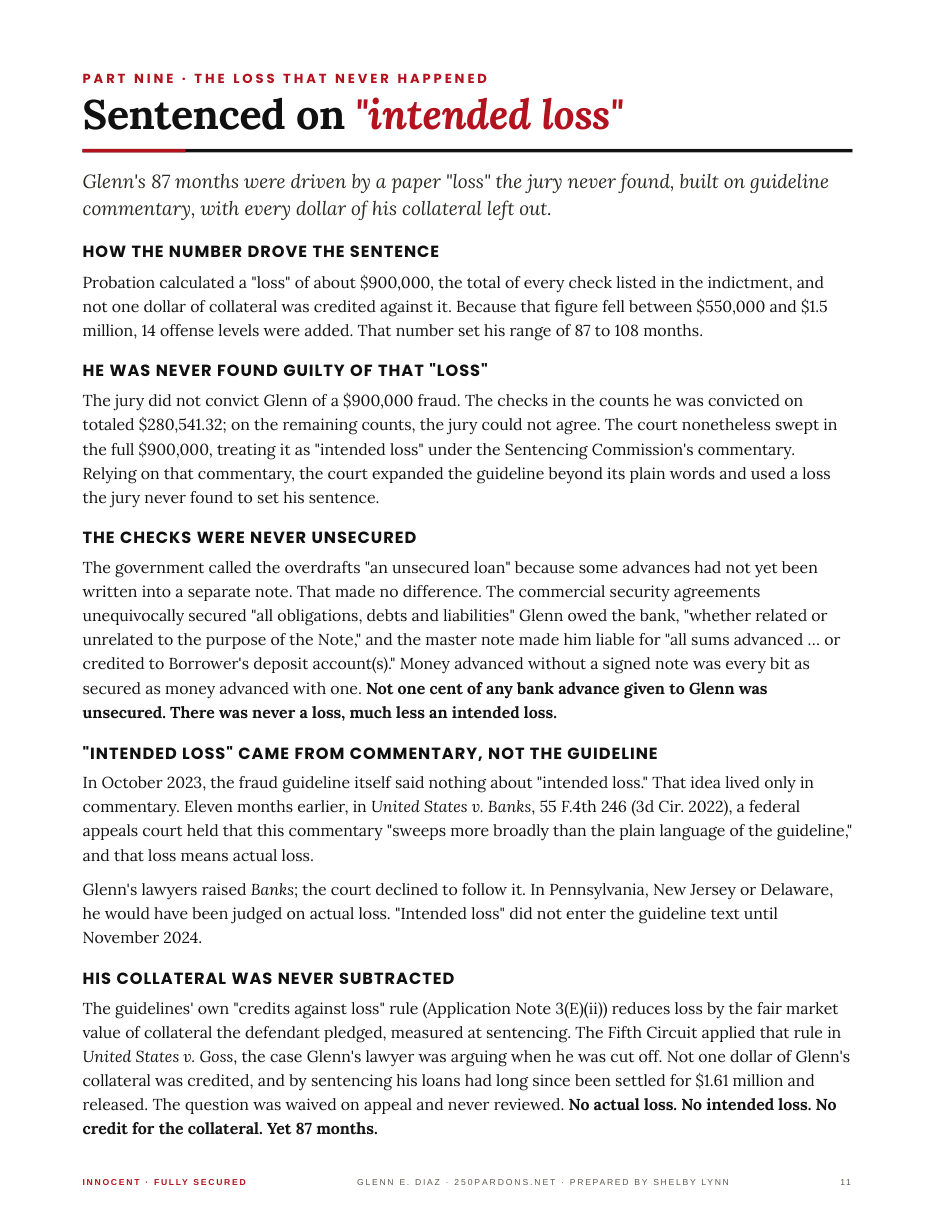
Probation calculated a "loss" of about $900,000, the total of every check listed in the indictment, and not one dollar of collateral was credited against it. Because that figure fell between $550,000 and $1.5 million, 14 offense levels were added. That number set his range of 87 to 108 months.
HE WAS NEVER FOUND GUILTY OF THAT "LOSS"
The jury did not convict Glenn of a $900,000 fraud. The checks in the counts he was convicted on totaled $280,541.32; on the remaining counts, the jury could not agree. The court nonetheless swept in the full $900,000, treating it as "intended loss" under the Sentencing Commission's commentary. Relying on that commentary, the court expanded the guideline beyond its plain words and used a loss the jury never found to set his sentence.
THE CHECKS WERE NEVER UNSECURED
The government called the overdrafts "an unsecured loan" because some advances had not yet been written into a separate note. That made no difference. The commercial security agreements unequivocally secured "all obligations, debts and liabilities" Glenn owed the bank, "whether related or unrelated to the purpose of the Note," and the master note made him liable for "all sums advanced … or credited to Borrower's deposit account(s)." Money advanced without a signed note was every bit as secured as money advanced with one. Not one cent of any bank advance given to Glenn was unsecured. There was never a loss, much less an intended loss.
"INTENDED LOSS" CAME FROM COMMENTARY, NOT THE GUIDELINE
In October 2023, the fraud guideline itself said nothing about "intended loss." That idea lived only in commentary. Eleven months earlier, in United States v. Banks, 55 F.4th 246 (3d Cir. 2022), a federal appeals court held that this commentary "sweeps more broadly than the plain language of the guideline," and that loss means actual loss.
Glenn's lawyers raised Banks; the court declined to follow it. In Pennsylvania, New Jersey or Delaware, he would have been judged on actual loss. "Intended loss" did not enter the guideline text until November 2024.
HIS COLLATERAL WAS NEVER SUBTRACTED
The guidelines' own "credits against loss" rule (Application Note 3(E)(ii)) reduces loss by the fair market value of collateral the defendant pledged, measured at sentencing. The Fifth Circuit applied that rule in United States v. Goss, the case Glenn's lawyer was arguing when he was cut off. Not one dollar of Glenn's collateral was credited, and by sentencing his loans had long since been settled for $1.61 million and released. The question was waived on appeal and never reviewed. No actual loss. No intended loss. No credit for the collateral. Yet 87 months.
View page 12 as designed (charts and tables)
Page 13
PART TEN · A WEAPONIZED PROSECUTION
The full power of the government, aimed at the wrong man
First NBC was destroyed from the inside by its own executives. It was stipulated at trial that Glenn had nothing to do with its failure. Yet the government chose to treat a fully secured customer as a criminal.
CHARGES PILED ON CHARGES
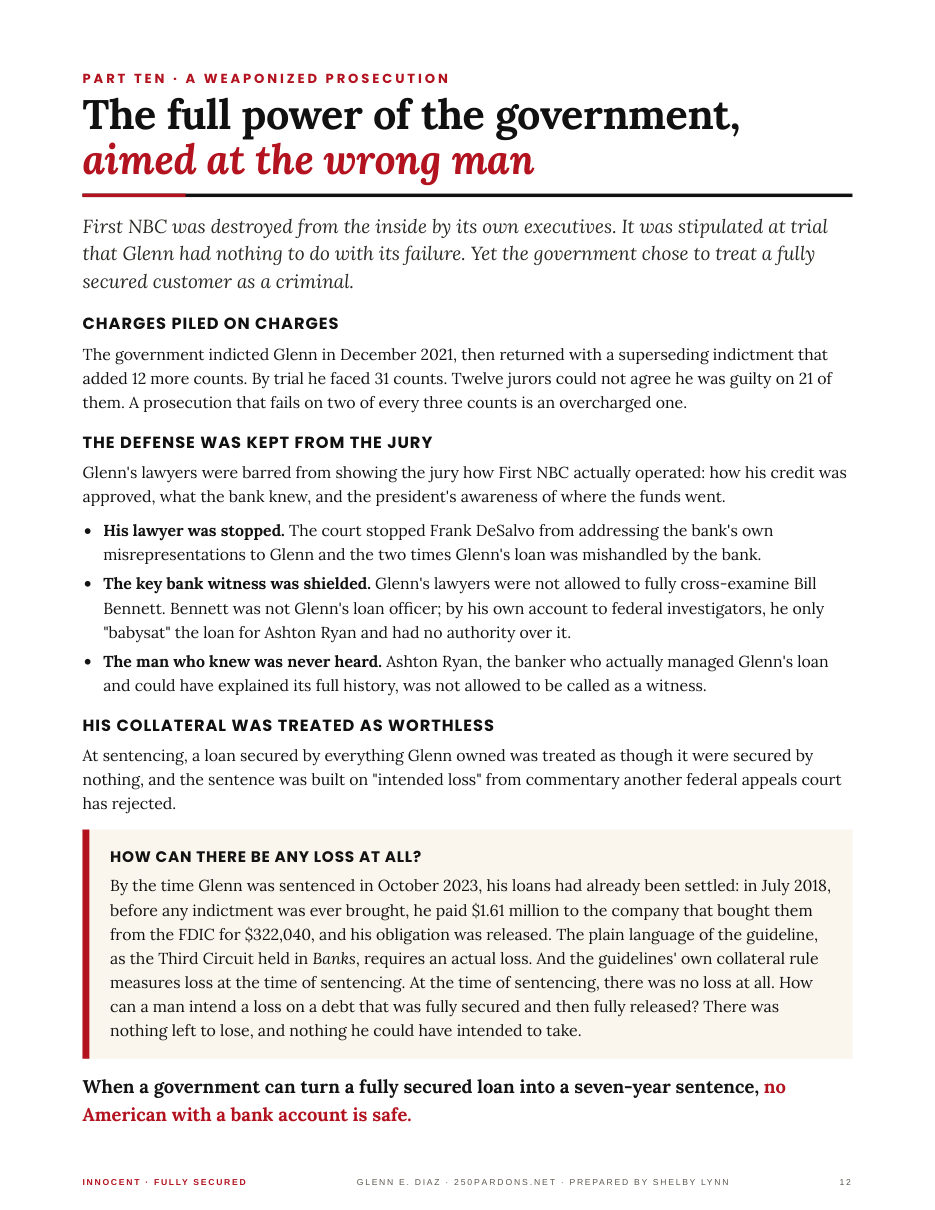
The government indicted Glenn in December 2021, then returned with a superseding indictment that added 12 more counts. By trial he faced 31 counts. Twelve jurors could not agree he was guilty on 21 of them. A prosecution that fails on two of every three counts is an overcharged one.
THE DEFENSE WAS KEPT FROM THE JURY
Glenn's lawyers were barred from showing the jury how First NBC actually operated: how his credit was approved, what the bank knew, and the president's awareness of where the funds went.
His lawyer was stopped. The court stopped Frank DeSalvo from addressing the bank's own misrepresentations to Glenn and the two times Glenn's loan was mishandled by the bank. The key bank witness was shielded. Glenn's lawyers were not allowed to fully cross-examine Bill Bennett. Bennett was not Glenn's loan officer; by his own account to federal investigators, he only "babysat" the loan for Ashton Ryan and had no authority over it. The man who knew was never heard. Ashton Ryan, the banker who actually managed Glenn's loan and could have explained its full history, was not allowed to be called as a witness.
HIS COLLATERAL WAS TREATED AS WORTHLESS
At sentencing, a loan secured by everything Glenn owned was treated as though it were secured by nothing, and the sentence was built on "intended loss" from commentary another federal appeals court has rejected.
HOW CAN THERE BE ANY LOSS AT ALL?
By the time Glenn was sentenced in October 2023, his loans had already been settled: in July 2018, before any indictment was ever brought, he paid $1.61 million to the company that bought them from the FDIC for $322,040, and his obligation was released. The plain language of the guideline, as the Third Circuit held in Banks, requires an actual loss. And the guidelines' own collateral rule measures loss at the time of sentencing. At the time of sentencing, there was no loss at all. How can a man intend a loss on a debt that was fully secured and then fully released? There was nothing left to lose, and nothing he could have intended to take.
When a government can turn a fully secured loan into a seven-year sentence, no American with a bank account is safe.
View page 13 as designed (charts and tables)
Page 14
PART ELEVEN · PUNISHED FOR TRIAL
Same trial. Punished for innocence.
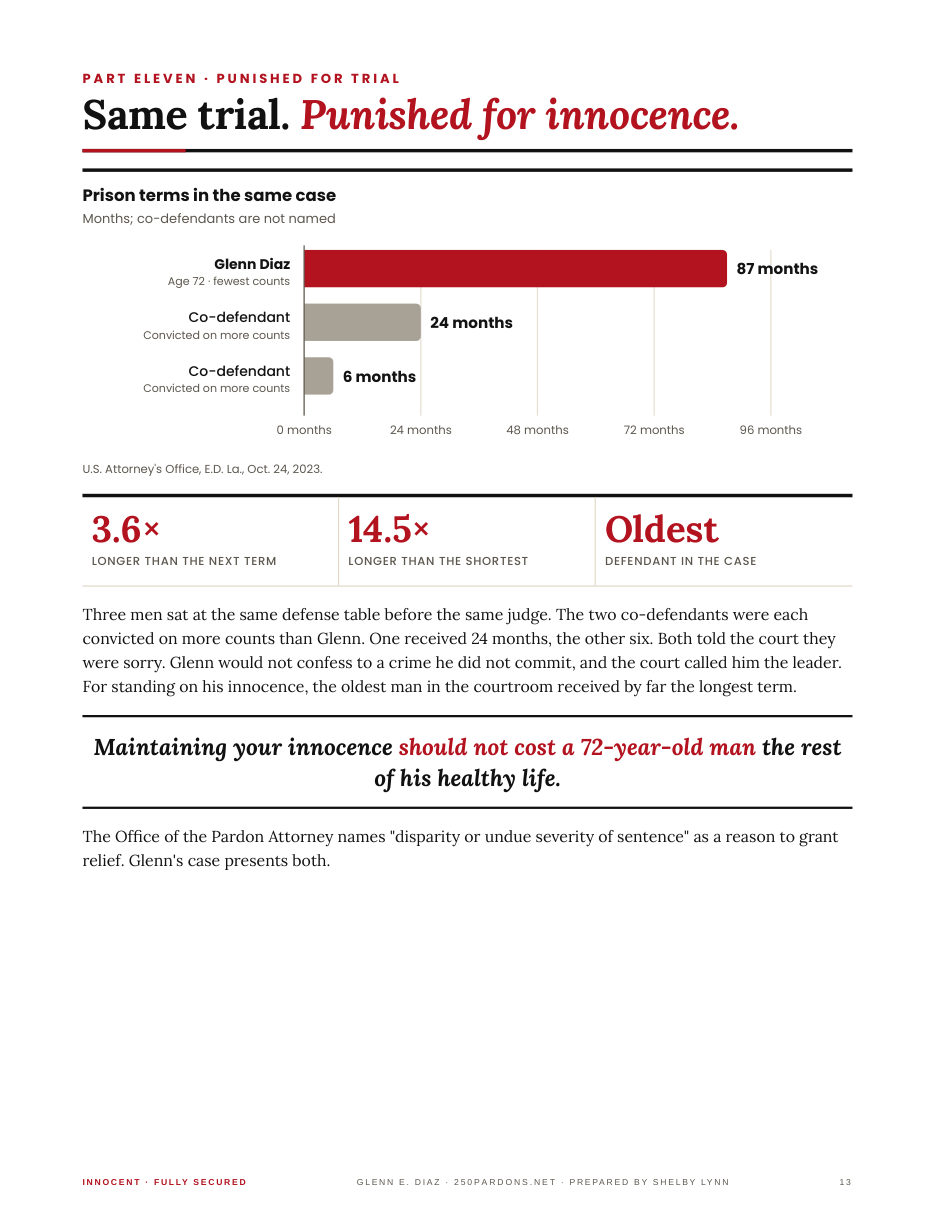
Prison terms in the same case
Months; co-defendants are not named
Glenn Diaz
87 months
Age 72 · fewest counts
Co-defendant
24 months
Convicted on more counts
Co-defendant
6 months
Convicted on more counts
0 months
24 months
48 months
72 months
96 months
U.S. Attorney's Office, E.D. La., Oct. 24, 2023.
Three men sat at the same defense table before the same judge. The two co-defendants were each convicted on more counts than Glenn. One received 24 months, the other six. Both told the court they were sorry. Glenn would not confess to a crime he did not commit, and the court called him the leader. For standing on his innocence, the oldest man in the courtroom received by far the longest term.
Maintaining your innocence should not cost a 72-year-old man the rest of his healthy life.
The Office of the Pardon Attorney names "disparity or undue severity of sentence" as a reason to grant relief. Glenn's case presents both.
View page 14 as designed (charts and tables)
Page 15
PART TWELVE · PUBLIC SAFETY
The data says: he is no risk
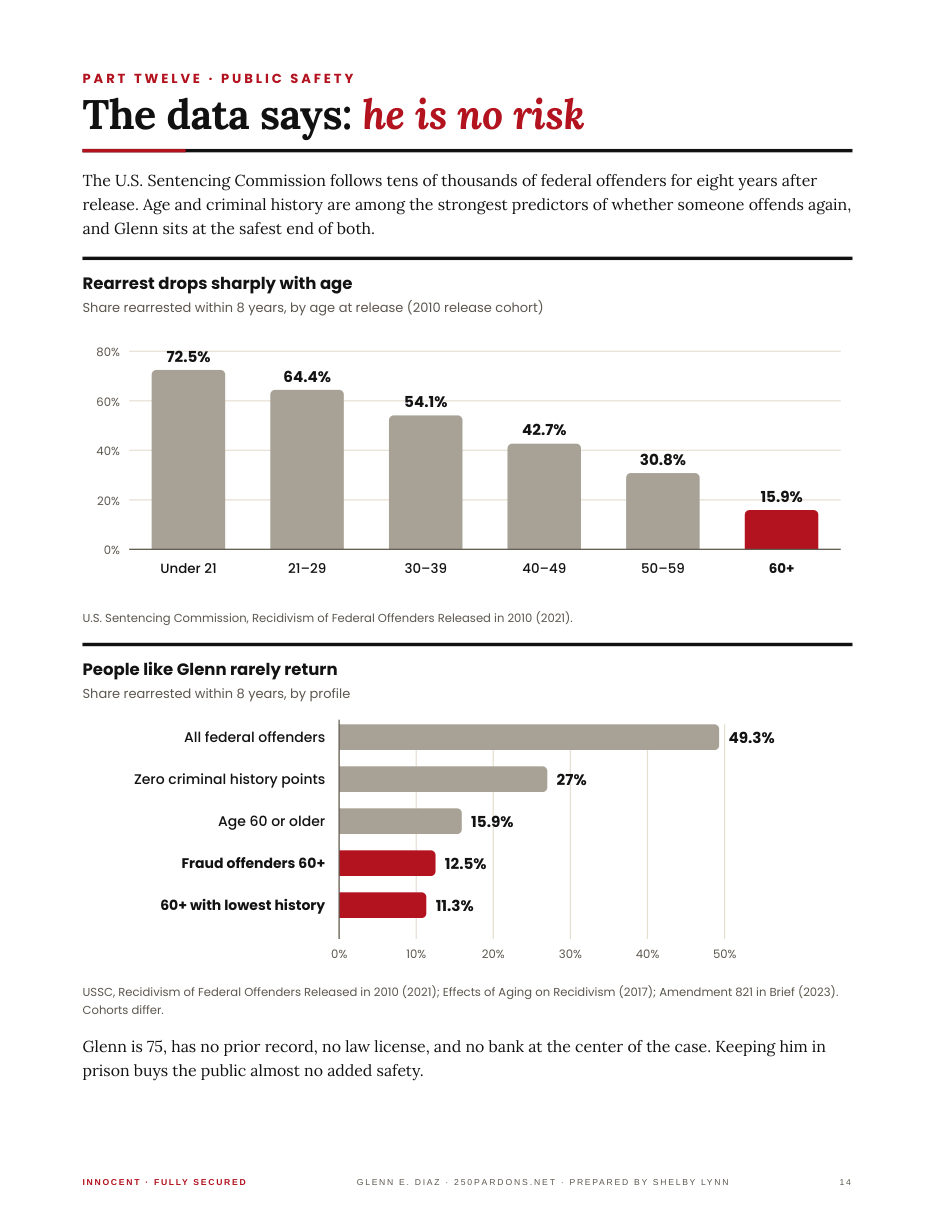
The U.S. Sentencing Commission follows tens of thousands of federal offenders for eight years after release. Age and criminal history are among the strongest predictors of whether someone offends again, and Glenn sits at the safest end of both.
Rearrest drops sharply with age
Share rearrested within 8 years, by age at release (2010 release cohort)
80%
72.5%
64.4%
54.1%
60%
42.7%
40%
30.8%
15.9%
20%
0%
Under 21
21–29
30–39
40–49
50–59
60+
U.S. Sentencing Commission, Recidivism of Federal Offenders Released in 2010 (2021).
People like Glenn rarely return
Share rearrested within 8 years, by profile
All federal offenders
49.3%
Zero criminal history points
27%
Age 60 or older
15.9%
Fraud offenders 60+
12.5%
60+ with lowest history
11.3%
0%
10%
20%
30%
40%
50%
USSC, Recidivism of Federal Offenders Released in 2010 (2021); Effects of Aging on Recidivism (2017); Amendment 821 in Brief (2023).
Cohorts differ.
Glenn is 75, has no prior record, no law license, and no bank at the center of the case. Keeping him in prison buys the public almost no added safety.
View page 15 as designed (charts and tables)
Page 16
PART THIRTEEN · COST
Taxpayers pay more than the case was about
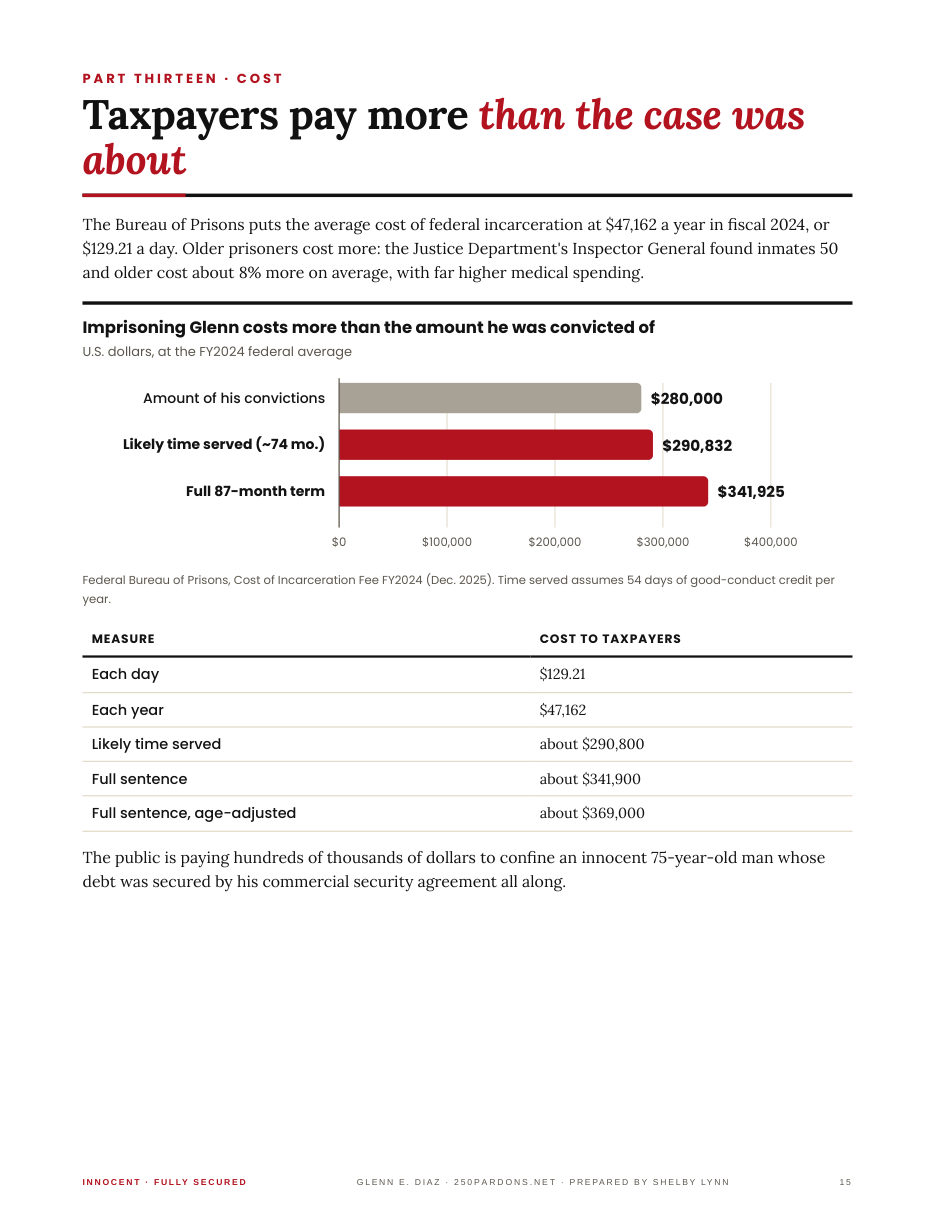
The Bureau of Prisons puts the average cost of federal incarceration at $47,162 a year in fiscal 2024, or $129.21 a day. Older prisoners cost more: the Justice Department's Inspector General found inmates 50 and older cost about 8% more on average, with far higher medical spending.
Imprisoning Glenn costs more than the amount he was convicted of
U.S. dollars, at the FY2024 federal average
Amount of his convictions
$280,000
Likely time served (~74 mo.)
$290,832
Full 87-month term
$341,925
$0
$100,000
$200,000
$300,000
$400,000
Federal Bureau of Prisons, Cost of Incarceration Fee FY2024 (Dec. 2025). Time served assumes 54 days of good-conduct credit per
year.
MEASURE
COST TO TAXPAYERS
Each day
$129.21
Each year
$47,162
Likely time served
about $290,800
Full sentence
about $341,900
Full sentence, age-adjusted
about $369,000
The public is paying hundreds of thousands of dollars to confine an innocent 75-year-old man whose debt was secured by his commercial security agreement all along.
View page 16 as designed (charts and tables)
Page 17
PART FOURTEEN · THE STANDARDS
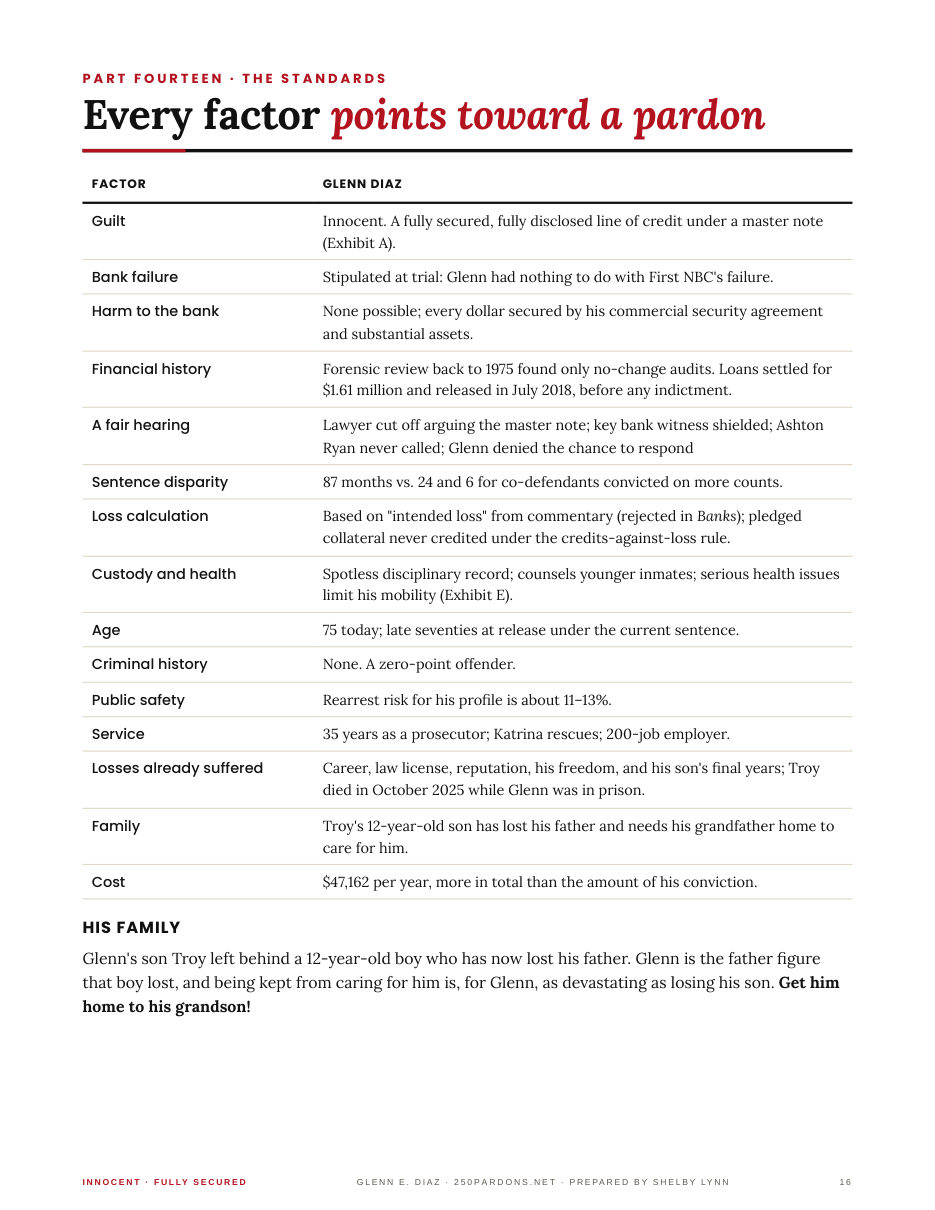
Every factor points toward a pardon
FACTOR
GLENN DIAZ
Guilt
Innocent. A fully secured, fully disclosed line of credit under a master note
(Exhibit A).
Bank failure
Stipulated at trial: Glenn had nothing to do with First NBC's failure.
Harm to the bank
None possible; every dollar secured by his commercial security agreement
and substantial assets.
Financial history
Forensic review back to 1975 found only no-change audits. Loans settled for
$1.61 million and released in July 2018, before any indictment.
A fair hearing
Lawyer cut off arguing the master note; key bank witness shielded; Ashton
Ryan never called; Glenn denied the chance to respond
Sentence disparity
87 months vs. 24 and 6 for co-defendants convicted on more counts.
Loss calculation
Based on "intended loss" from commentary (rejected in Banks); pledged
collateral never credited under the credits-against-loss rule.
Custody and health
Spotless disciplinary record; counsels younger inmates; serious health issues
limit his mobility (Exhibit E).
Age
75 today; late seventies at release under the current sentence.
Criminal history
None. A zero-point offender.
Public safety
Rearrest risk for his profile is about 11–13%.
Service
35 years as a prosecutor; Katrina rescues; 200-job employer.
Losses already suffered
Career, law license, reputation, his freedom, and his son's final years; Troy
died in October 2025 while Glenn was in prison.
Family
Troy's 12-year-old son has lost his father and needs his grandfather home to
care for him.
Cost
$47,162 per year, more in total than the amount of his conviction.
HIS FAMILY
Glenn's son Troy left behind a 12-year-old boy who has now lost his father. Glenn is the father figure that boy lost, and being kept from caring for him is, for Glenn, as devastating as losing his son. Get him home to his grandson!
View page 17 as designed (charts and tables)
Page 18
PART FIFTEEN · THE VOICE OF HIS PARISH
"Bring Mr. Diaz home where he belongs"
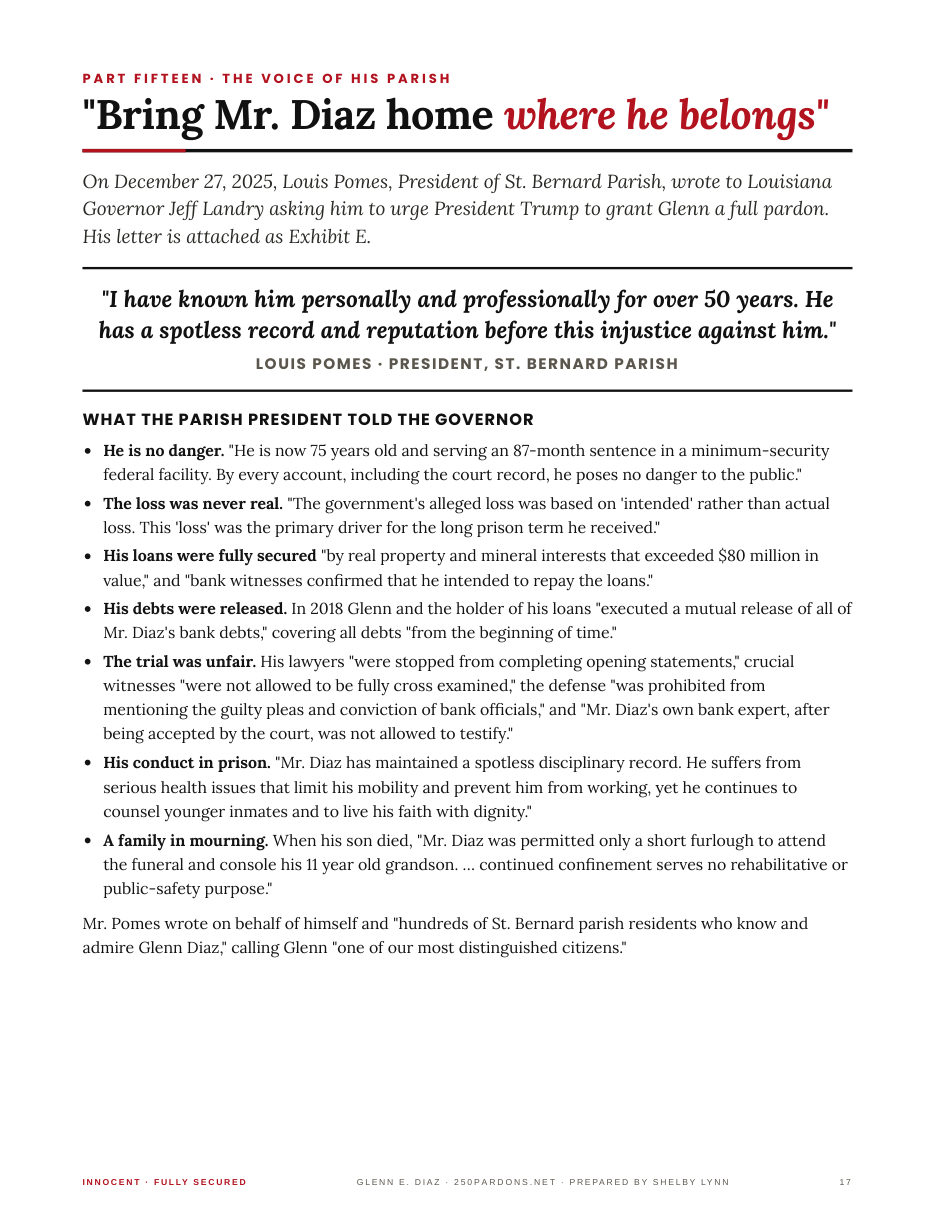
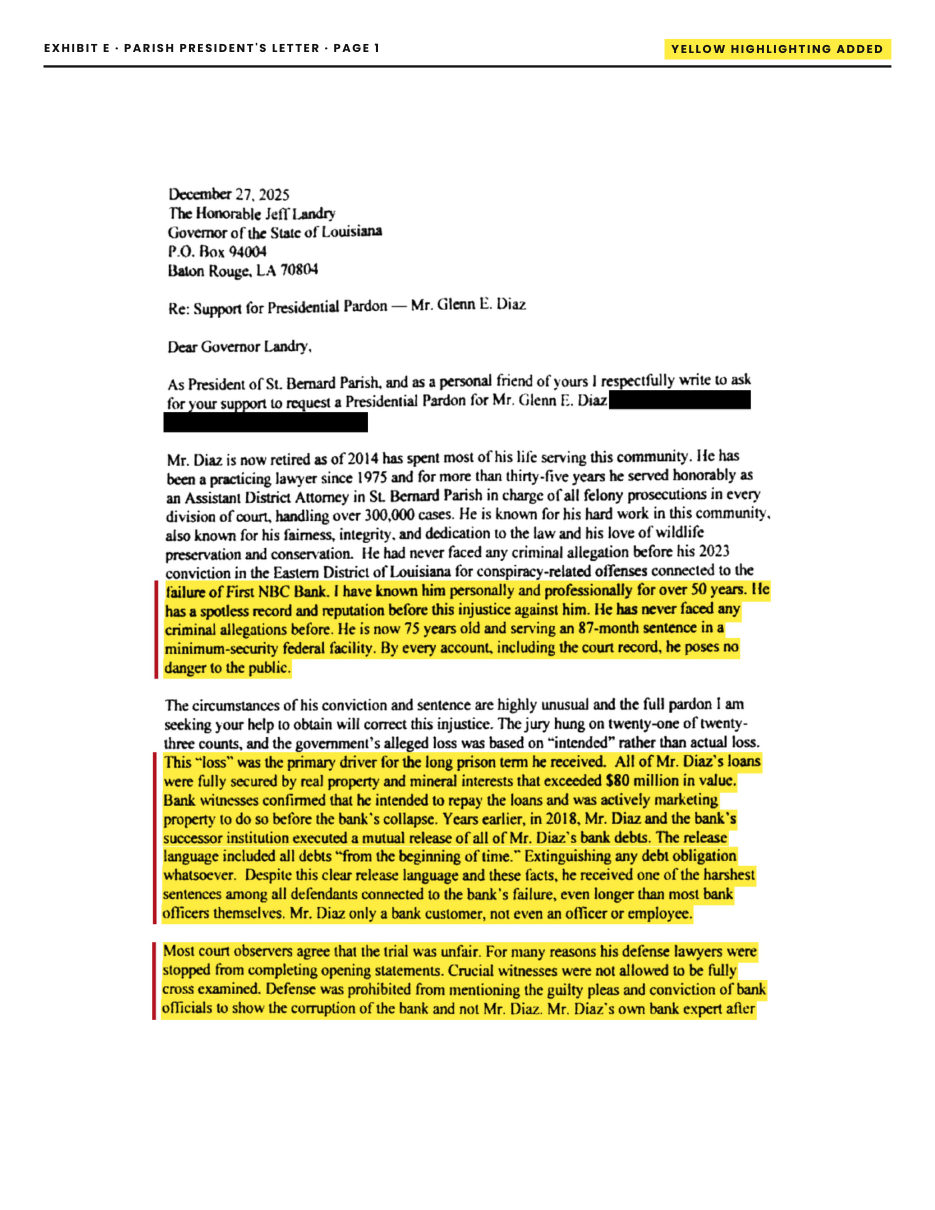
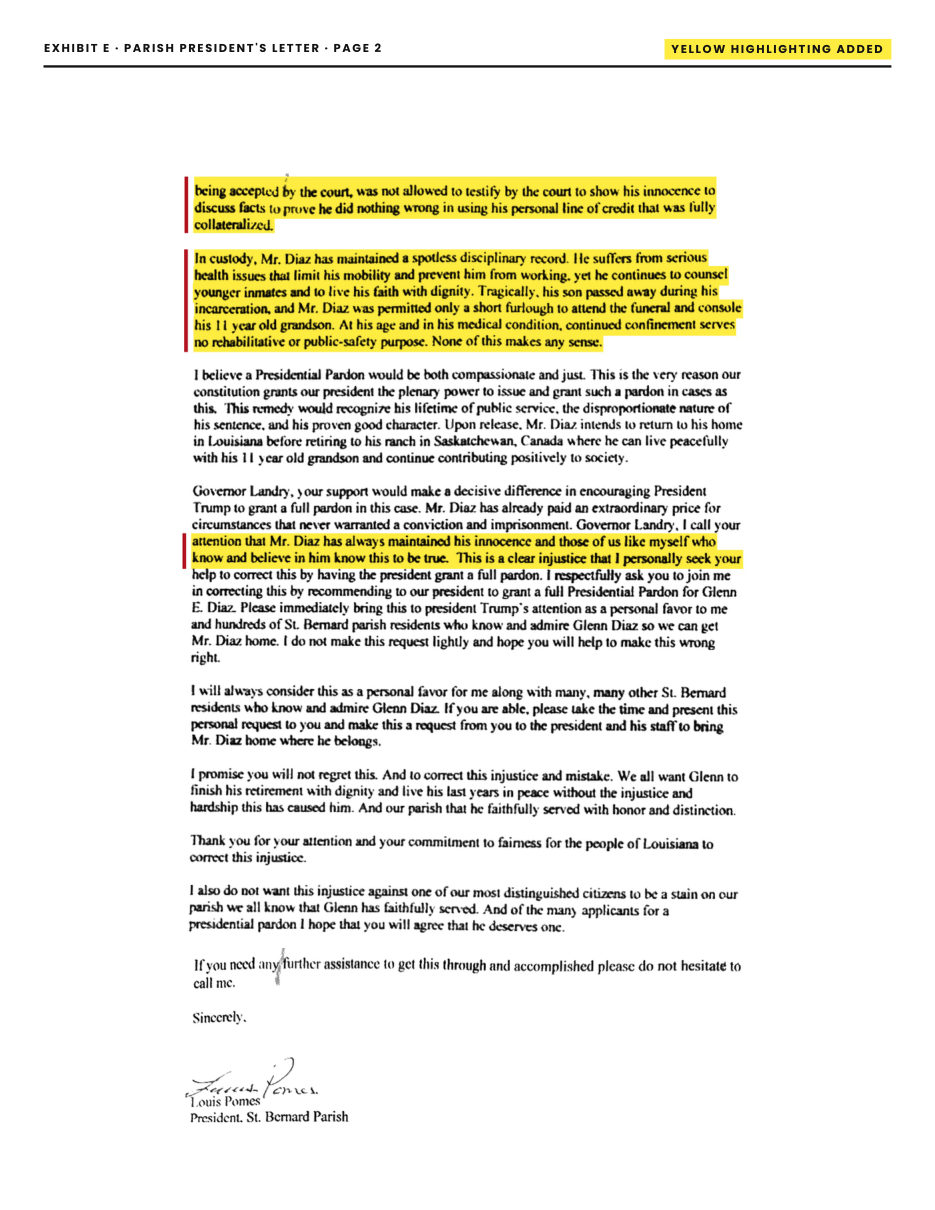
On December 27, 2025, Louis Pomes, President of St. Bernard Parish, wrote to Louisiana Governor Jeff Landry asking him to urge President Trump to grant Glenn a full pardon. His letter is attached as Exhibit E.
"I have known him personally and professionally for over 50 years. He has a spotless record and reputation before this injustice against him."
LOUIS POMES · PRESIDENT, ST. BERNARD PARISH
WHAT THE PARISH PRESIDENT TOLD THE GOVERNOR
He is no danger. "He is now 75 years old and serving an 87-month sentence in a minimum-security federal facility. By every account, including the court record, he poses no danger to the public." The loss was never real. "The government's alleged loss was based on 'intended' rather than actual loss. This 'loss' was the primary driver for the long prison term he received." His loans were fully secured "by real property and mineral interests that exceeded $80 million in value," and "bank witnesses confirmed that he intended to repay the loans." His debts were released. In 2018 Glenn and the holder of his loans "executed a mutual release of all of Mr. Diaz's bank debts," covering all debts "from the beginning of time." The trial was unfair. His lawyers "were stopped from completing opening statements," crucial witnesses "were not allowed to be fully cross examined," the defense "was prohibited from mentioning the guilty pleas and conviction of bank officials," and "Mr. Diaz's own bank expert, after being accepted by the court, was not allowed to testify." His conduct in prison. "Mr. Diaz has maintained a spotless disciplinary record. He suffers from serious health issues that limit his mobility and prevent him from working, yet he continues to counsel younger inmates and to live his faith with dignity." A family in mourning. When his son died, "Mr. Diaz was permitted only a short furlough to attend the funeral and console his 11 year old grandson. … continued confinement serves no rehabilitative or public-safety purpose."
Mr. Pomes wrote on behalf of himself and "hundreds of St. Bernard parish residents who know and admire Glenn Diaz," calling Glenn "one of our most distinguished citizens."
View page 18 as designed (charts and tables)
Page 19
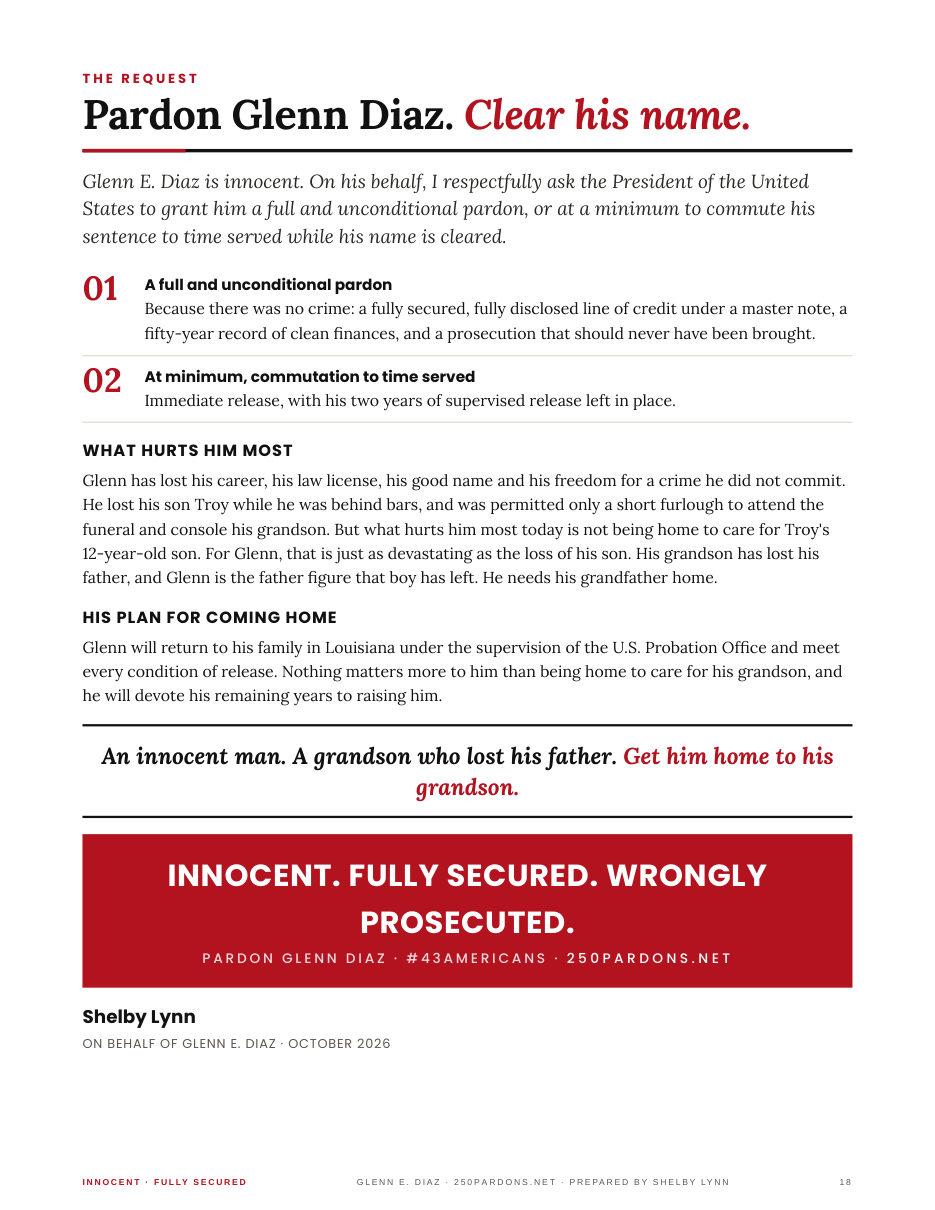
THE REQUEST
Pardon Glenn Diaz. Clear his name.
Glenn E. Diaz is innocent. On his behalf, I respectfully ask the President of the United States to grant him a full and unconditional pardon, or at a minimum to commute his sentence to time served while his name is cleared.
A full and unconditional pardon
Because there was no crime: a fully secured, fully disclosed line of credit under a master note, a fifty-year record of clean finances, and a prosecution that should never have been brought.
At minimum, commutation to time served
Immediate release, with his two years of supervised release left in place.
WHAT HURTS HIM MOST
Glenn has lost his career, his law license, his good name and his freedom for a crime he did not commit. He lost his son Troy while he was behind bars, and was permitted only a short furlough to attend the funeral and console his grandson. But what hurts him most today is not being home to care for Troy's 12-year-old son. For Glenn, that is just as devastating as the loss of his son. His grandson has lost his father, and Glenn is the father figure that boy has left. He needs his grandfather home.
HIS PLAN FOR COMING HOME
Glenn will return to his family in Louisiana under the supervision of the U.S. Probation Office and meet every condition of release. Nothing matters more to him than being home to care for his grandson, and he will devote his remaining years to raising him.
An innocent man. A grandson who lost his father. Get him home to his grandson.
INNOCENT. FULLY SECURED. WRONGLY
PROSECUTED.
PARDON GLENN DIAZ · #43AMERICANS ·
250PARDONS.NET
Shelby Lynn
ON BEHALF OF GLENN E. DIAZ · OCTOBER 2026
View page 19 as designed (charts and tables)
Page 20
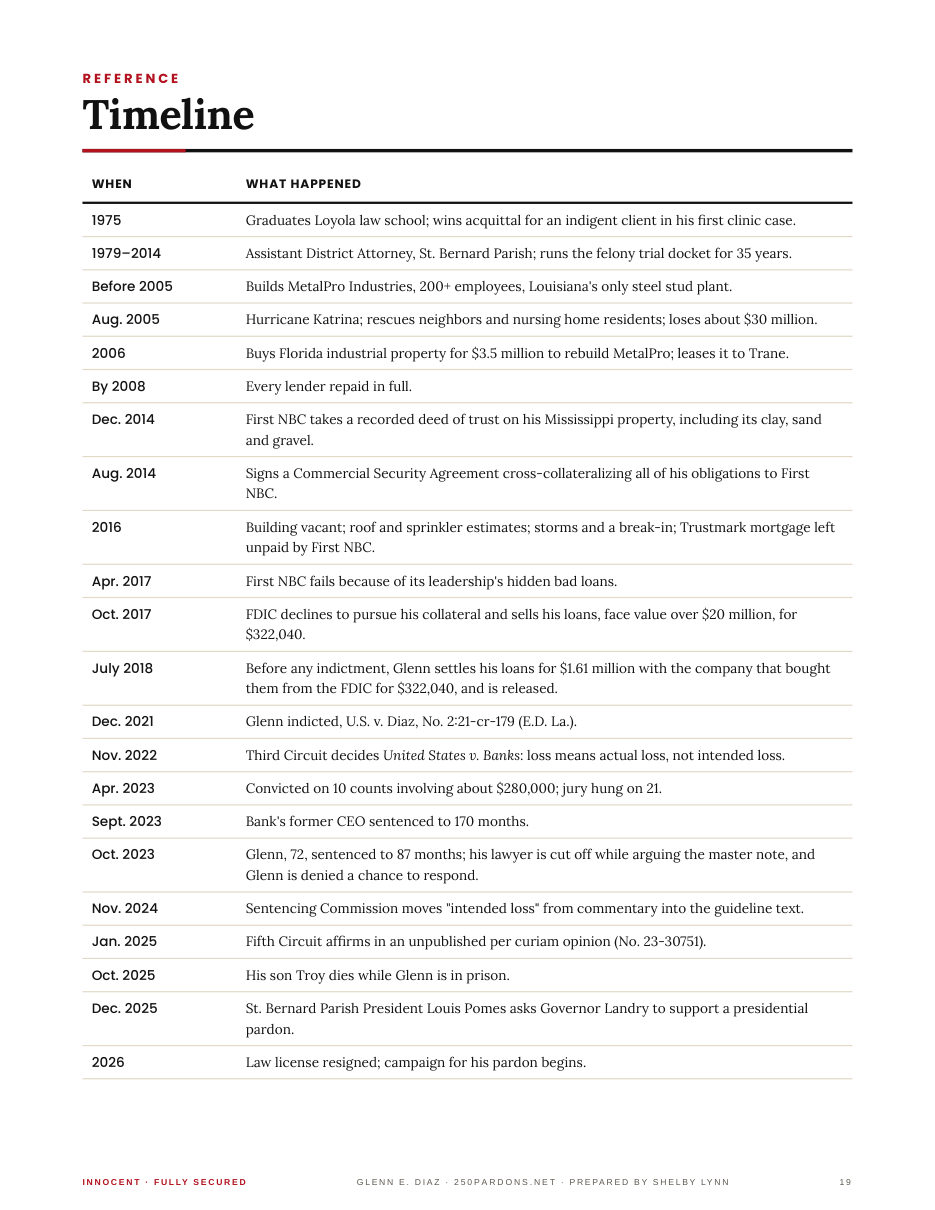
REFERENCE
Timeline
| WHEN | WHAT HAPPENED |
|---|---|
| 1975 | Graduates Loyola law school; wins acquittal for an indigent client in his first clinic case. |
| 1979–2014 | Assistant District Attorney, St. Bernard Parish; runs the felony trial docket for 35 years. |
| Before 2005 | Builds MetalPro Industries, 200+ employees, Louisiana's only steel stud plant. |
| Aug. 2005 | Hurricane Katrina; rescues neighbors and nursing home residents; loses about $30 million. |
| 2006 | Buys Florida industrial property for $3.5 million to rebuild MetalPro; leases it to Trane. |
| By 2008 | Every lender repaid in full. |
| Dec. 2014 | First NBC takes a recorded deed of trust on his Mississippi property, including its clay, sand and gravel. |
| Aug. 2014 | Signs a Commercial Security Agreement cross-collateralizing all of his obligations to First NBC. |
| 2016 | Building vacant; roof and sprinkler estimates; storms and a break-in; Trustmark mortgage left unpaid by First NBC. |
| Apr. 2017 | First NBC fails because of its leadership's hidden bad loans. |
| Oct. 2017 | FDIC declines to pursue his collateral and sells his loans, face value over $20 million, for $322,040. |
| July 2018 | Before any indictment, Glenn settles his loans for $1.61 million with the company that bought them from the FDIC for $322,040, and is released. |
| Dec. 2021 | Glenn indicted, U.S. v. Diaz, No. 2:21-cr-179 (E.D. La.). |
| Nov. 2022 | Third Circuit decides United States v. Banks: loss means actual loss, not intended loss. |
| Apr. 2023 | Convicted on 10 counts involving about $280,000; jury hung on 21. |
| Sept. 2023 | Bank's former CEO sentenced to 170 months. |
| Oct. 2023 | Glenn, 72, sentenced to 87 months; his lawyer is cut off while arguing the master note, and Glenn is denied a chance to respond. |
| Nov. 2024 | Sentencing Commission moves "intended loss" from commentary into the guideline text. |
| Jan. 2025 | Fifth Circuit affirms in an unpublished per curiam opinion (No. 23-30751). |
| Oct. 2025 | His son Troy dies while Glenn is in prison. |
| Dec. 2025 | St. Bernard Parish President Louis Pomes asks Governor Landry to support a presidential pardon. |
| 2026 | Law license resigned; campaign for his pardon begins. |
View page 20 as designed (charts and tables)
Page 21
REFERENCE
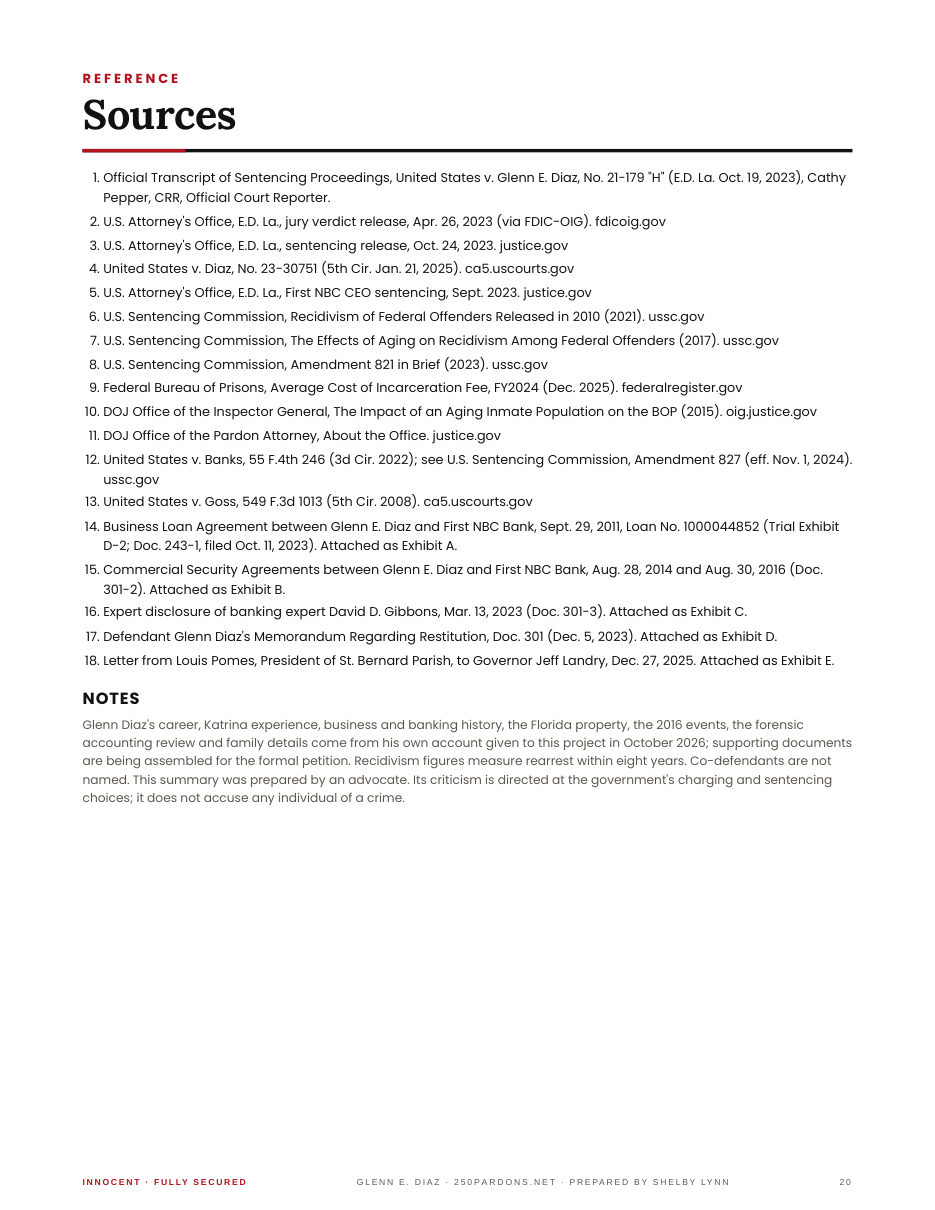
Sources
1. Official Transcript of Sentencing Proceedings, United States v. Glenn E. Diaz, No. 21-179 "H" (E.D. La. Oct. 19, 2023), Cathy
Pepper, CRR, Official Court Reporter.
2. U.S. Attorney's Office, E.D. La., jury verdict release, Apr. 26, 2023 (via FDIC-OIG). fdicoig.gov
3. U.S. Attorney's Office, E.D. La., sentencing release, Oct. 24, 2023. justice.gov
4. United States v. Diaz, No. 23-30751 (5th Cir. Jan. 21, 2025). ca5.uscourts.gov
5. U.S. Attorney's Office, E.D. La., First NBC CEO sentencing, Sept. 2023. justice.gov
6. U.S. Sentencing Commission, Recidivism of Federal Offenders Released in 2010 (2021). ussc.gov
7. U.S. Sentencing Commission, The Effects of Aging on Recidivism Among Federal Offenders (2017). ussc.gov
8. U.S. Sentencing Commission, Amendment 821 in Brief (2023). ussc.gov
9. Federal Bureau of Prisons, Average Cost of Incarceration Fee, FY2024 (Dec. 2025). federalregister.gov
10. DOJ Office of the Inspector General, The Impact of an Aging Inmate Population on the BOP (2015). oig.justice.gov
11. DOJ Office of the Pardon Attorney, About the Office. justice.gov
12. United States v. Banks, 55 F.4th 246 (3d Cir. 2022); see U.S. Sentencing Commission, Amendment 827 (eff. Nov. 1, 2024).
ussc.gov
13. United States v. Goss, 549 F.3d 1013 (5th Cir. 2008). ca5.uscourts.gov
14. Business Loan Agreement between Glenn E. Diaz and First NBC Bank, Sept. 29, 2011, Loan No. 1000044852 (Trial Exhibit
D-2; Doc. 243-1, filed Oct. 11, 2023). Attached as Exhibit A.
15. Commercial Security Agreements between Glenn E. Diaz and First NBC Bank, Aug. 28, 2014 and Aug. 30, 2016 (Doc.
301-2). Attached as Exhibit B.
16. Expert disclosure of banking expert David D. Gibbons, Mar. 13, 2023 (Doc. 301-3). Attached as Exhibit C.
17. Defendant Glenn Diaz's Memorandum Regarding Restitution, Doc. 301 (Dec. 5, 2023). Attached as Exhibit D.
18. Letter from Louis Pomes, President of St. Bernard Parish, to Governor Jeff Landry, Dec. 27, 2025. Attached as Exhibit E.
NOTES
Glenn Diaz's career, Katrina experience, business and banking history, the Florida property, the 2016 events, the forensic
accounting review and family details come from his own account given to this project in October 2026; supporting documents
are being assembled for the formal petition. Recidivism figures measure rearrest within eight years. Co-defendants are not
named. This summary was prepared by an advocate. Its criticism is directed at the government's charging and sentencing
choices; it does not accuse any individual of a crime.
View page 21 as designed (charts and tables)
Page 22
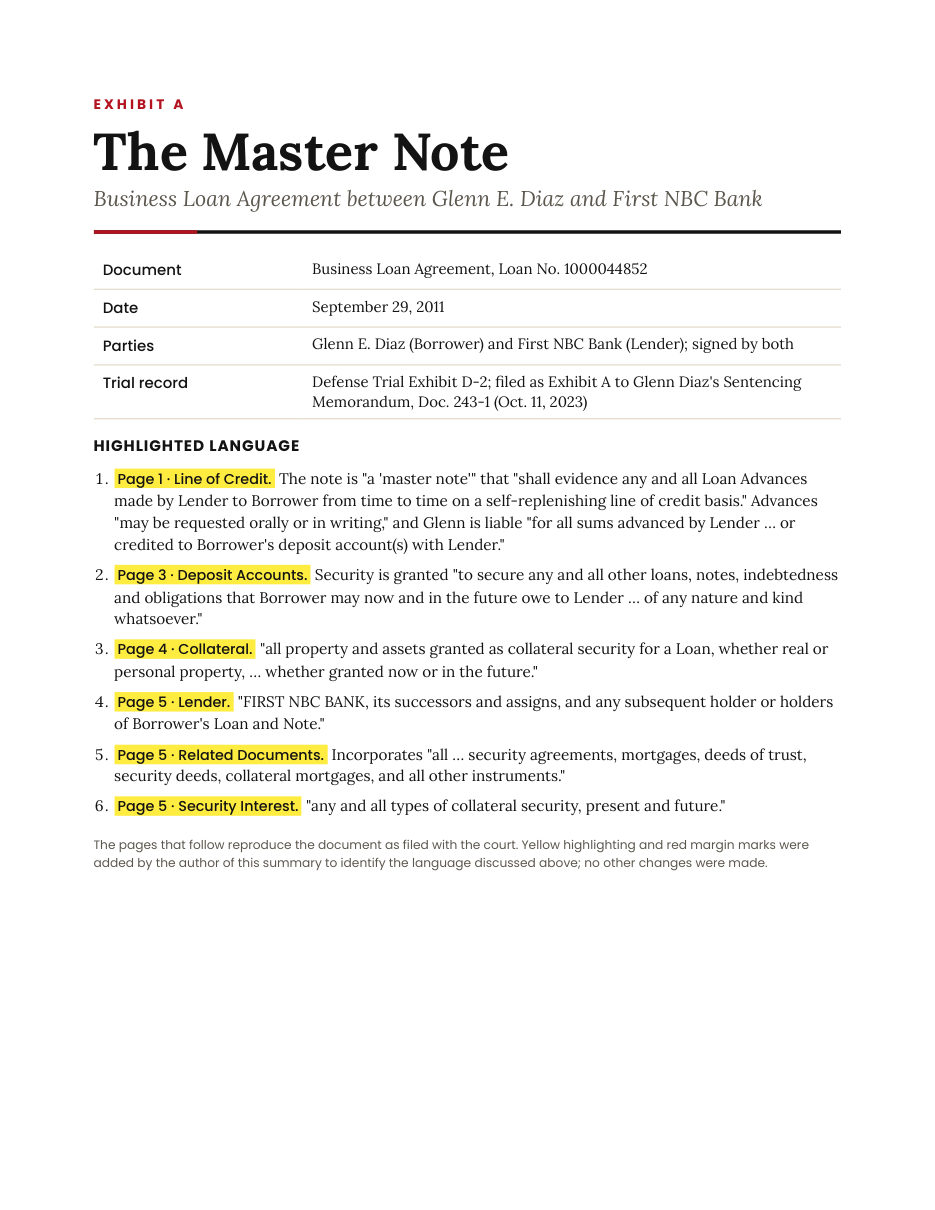
EXHIBIT A
The Master Note
Business Loan Agreement between Glenn E. Diaz and First NBC Bank
Document
Business Loan Agreement, Loan No. 1000044852
Date
September 29, 2011
Parties
Glenn E. Diaz (Borrower) and First NBC Bank (Lender); signed by both
Trial record
Defense Trial Exhibit D-2; filed as Exhibit A to Glenn Diaz's Sentencing
Memorandum, Doc. 243-1 (Oct. 11, 2023)
HIGHLIGHTED LANGUAGE
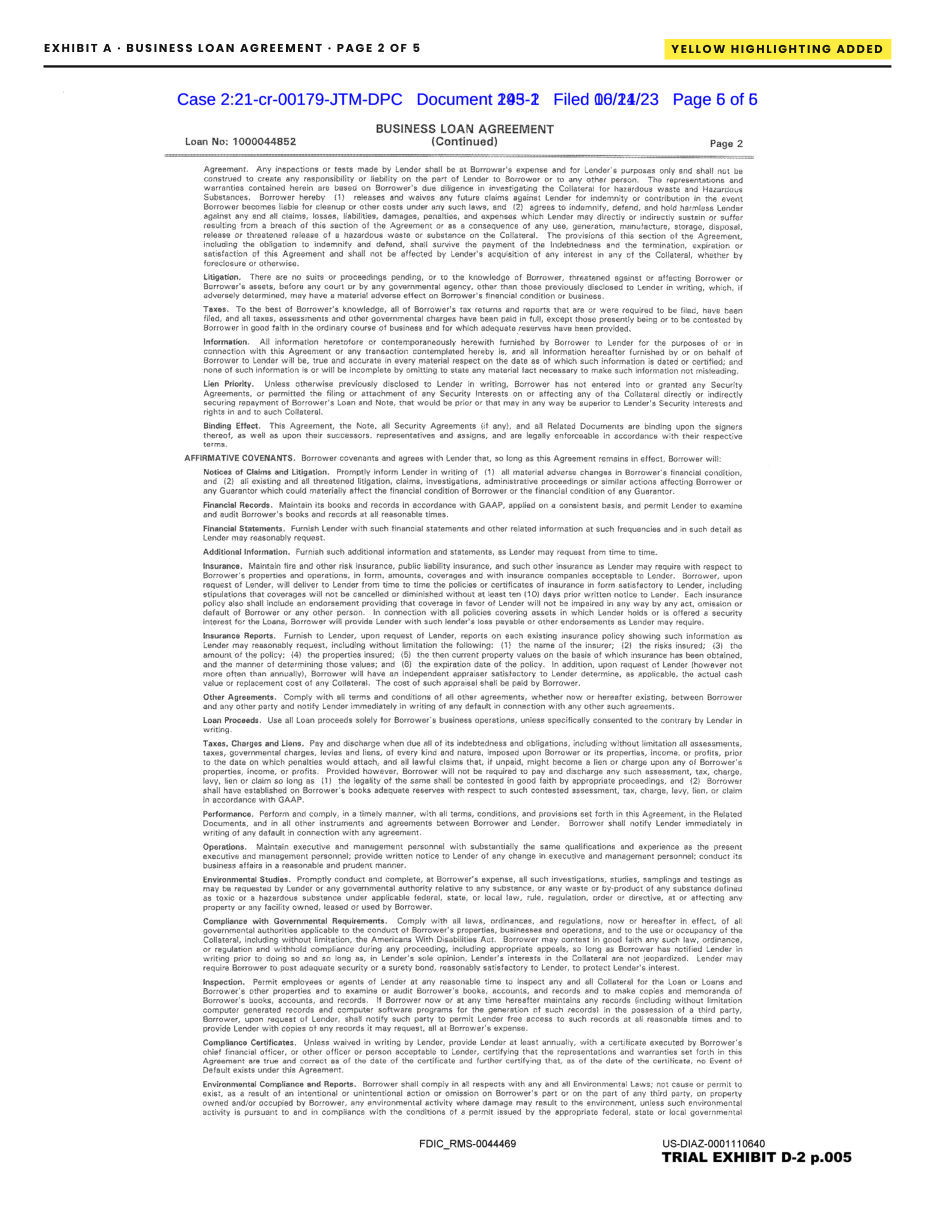
1. Page 1 · Line of Credit. The note is "a 'master note'" that "shall evidence any and all Loan Advances made by Lender to Borrower from time to time on a self-replenishing line of credit basis." Advances "may be requested orally or in writing," and Glenn is liable "for all sums advanced by Lender … or credited to Borrower's deposit account(s) with Lender." 2. Page 3 · Deposit Accounts. Security is granted "to secure any and all other loans, notes, indebtedness and obligations that Borrower may now and in the future owe to Lender … of any nature and kind whatsoever." 3. Page 4 · Collateral. "all property and assets granted as collateral security for a Loan, whether real or personal property, … whether granted now or in the future." 4. Page 5 · Lender. "FIRST NBC BANK, its successors and assigns, and any subsequent holder or holders of Borrower's Loan and Note." 5. Page 5 · Related Documents. Incorporates "all … security agreements, mortgages, deeds of trust, security deeds, collateral mortgages, and all other instruments." 6. Page 5 · Security Interest. "any and all types of collateral security, present and future."
The pages that follow reproduce the document as filed with the court. Yellow highlighting and red margin marks were
added by the author of this summary to identify the language discussed above; no other changes were made.
View page 22 as designed (charts and tables)
Page 23
EXHIBIT A · BUSINESS LOAN AGREEMENT · PAGE 1 OF 5
YELLOW HIGHLIGHTING ADDED
View page 23 as designed (charts and tables)
Page 24
EXHIBIT A · BUSINESS LOAN AGREEMENT · PAGE 2 OF 5
YELLOW HIGHLIGHTING ADDED
View page 24 as designed (charts and tables)
Page 25
EXHIBIT A · BUSINESS LOAN AGREEMENT · PAGE 3 OF 5
YELLOW HIGHLIGHTING ADDED
View page 25 as designed (charts and tables)
Page 26
EXHIBIT A · BUSINESS LOAN AGREEMENT · PAGE 4 OF 5
YELLOW HIGHLIGHTING ADDED
View page 26 as designed (charts and tables)
Page 27
EXHIBIT A · BUSINESS LOAN AGREEMENT · PAGE 5 OF 5
YELLOW HIGHLIGHTING ADDED
View page 27 as designed (charts and tables)
Page 28
EXHIBIT B
The Commercial Security Agreements
Commercial Security Agreements between Glenn E. Diaz and First NBC Bank
Documents
Commercial Security Agreements (Loan Nos. 1000044852 and 1000145249)
Dates
August 28, 2014 and August 30, 2016
Parties
Glenn E. Diaz (Grantor) and First NBC Bank (Lender); signed by Glenn
Court record
Exhibit B to Defendant Glenn Diaz's Memorandum Regarding Restitution,
Doc. 301-2 (Dec. 5, 2023)
HIGHLIGHTED LANGUAGE
1. Collateral Description. Collateral is property "whether now owned or hereafter acquired, whether now existing or hereafter arising, and wherever located." 2. Clay pit. The pledged clay pit in St. Bernard Parish "is estimated to contain thirty million (30,000,000) tons of clay material." 3. Cross-Collateralization. "In addition to the Note, this Agreement secures all obligations, debts and liabilities, plus interest thereon, of Grantor to Lender … whether now existing or hereafter arising, whether related or unrelated to the purpose of the Note." 4. Related Documents. Incorporates "all promissory notes, credit agreements, loan agreements, … security agreements, mortgages, deeds of trust, security deeds, collateral mortgages."
The pages that follow reproduce the document as filed with the court. Yellow highlighting and red margin marks were
added by the author of this summary to identify the language discussed above; no other changes were made.
View page 28 as designed (charts and tables)
Page 29
EXHIBIT B · AUG. 28, 2014 AGREEMENT · PAGE 1
YELLOW HIGHLIGHTING ADDED
View page 29 as designed (charts and tables)
Page 30
EXHIBIT B · AUG. 30, 2016 AGREEMENT · PAGE 1
YELLOW HIGHLIGHTING ADDED
View page 30 as designed (charts and tables)
Page 31
EXHIBIT B · AUG. 30, 2016 AGREEMENT · SIGNATURE PAGE
YELLOW HIGHLIGHTING ADDED
View page 31 as designed (charts and tables)
Page 32
EXHIBIT C
The Banking Expert
Expert disclosure of David D. Gibbons, bank supervision and credit risk expert
Document
Rule 16 expert disclosure, letter to the U.S. Attorney's Office
Date
March 13, 2023
Expert
David D. Gibbons; 27 years with the Office of the Comptroller of the
Currency
Court record
Exhibit C to Doc. 301 (Doc. 301-3); also Docs. 124-2 and 243-8
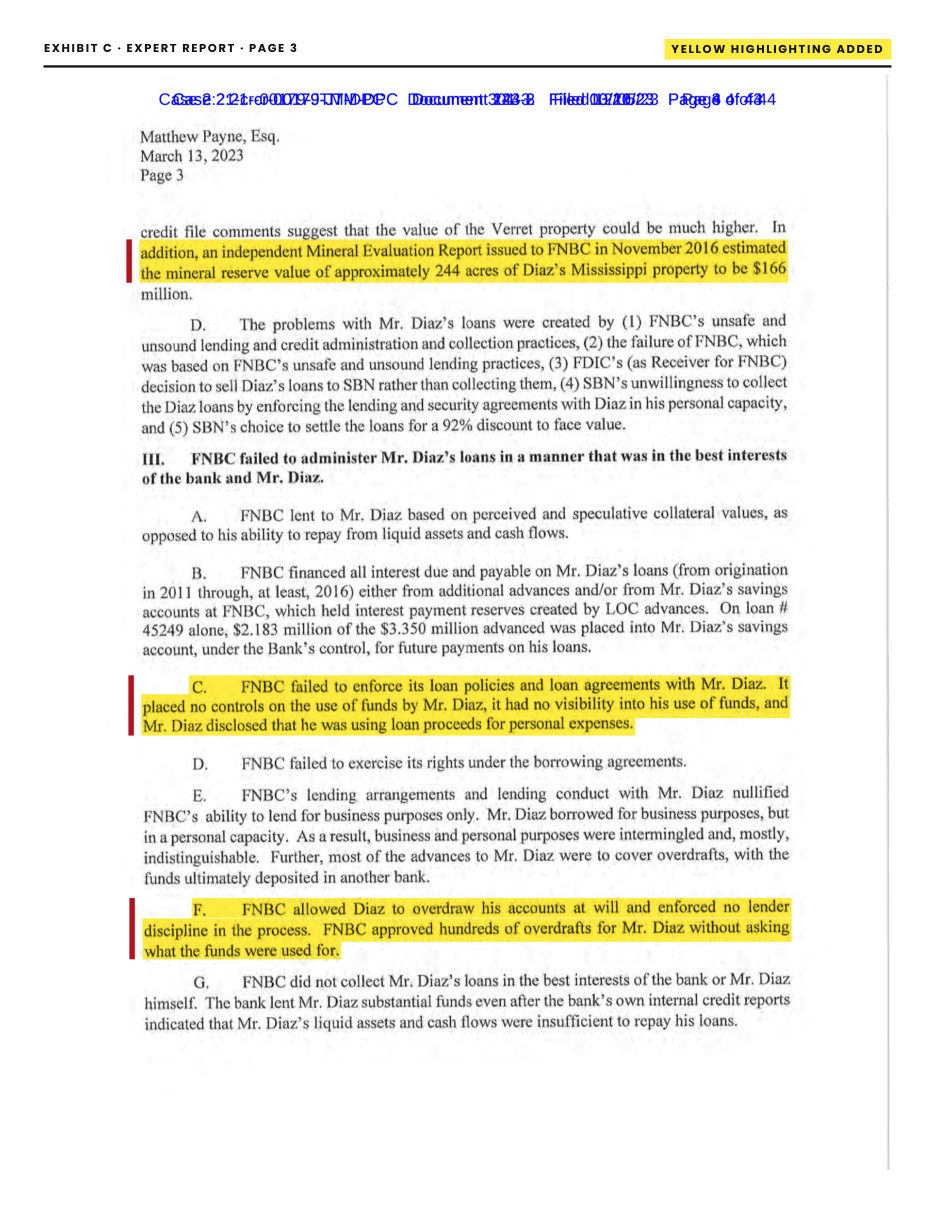
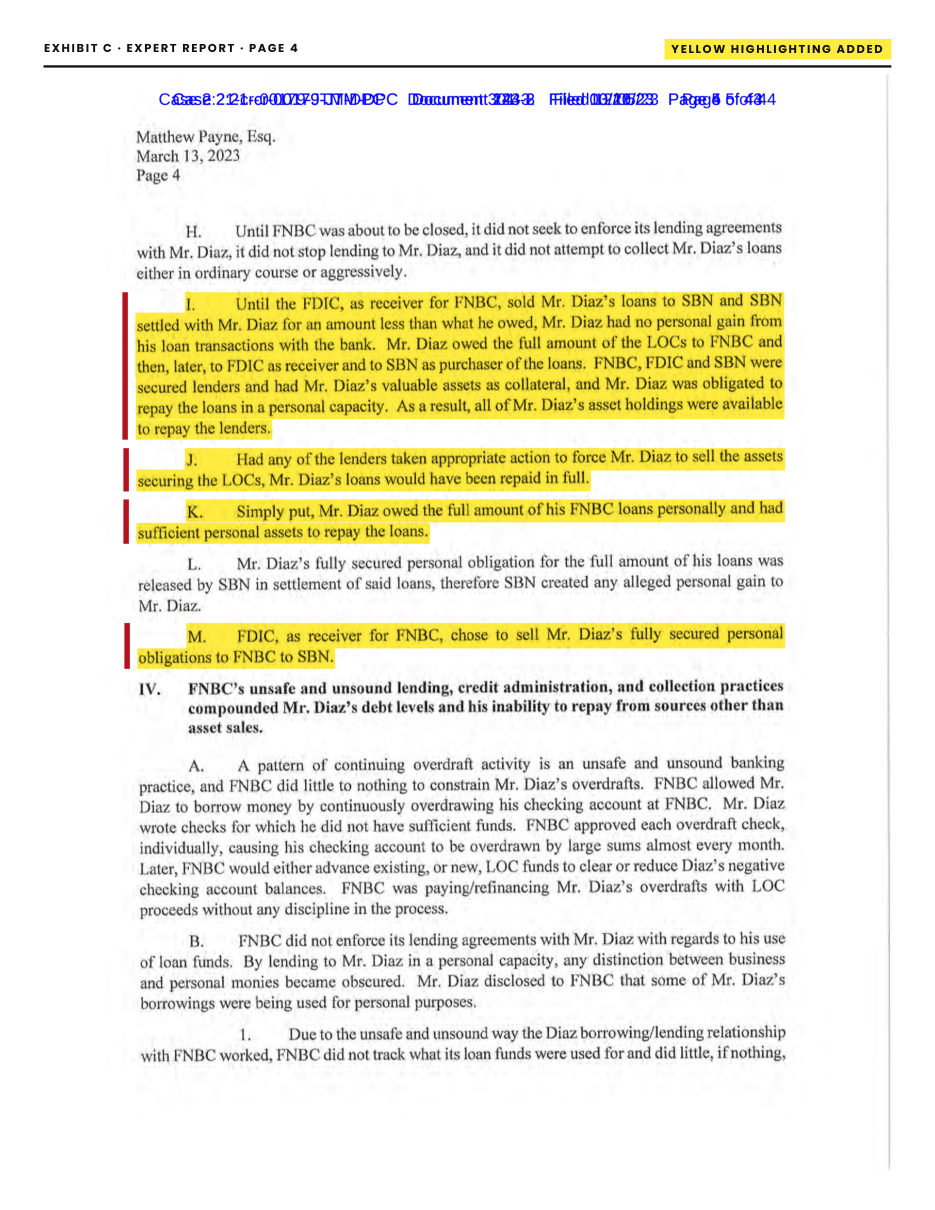
HIGHLIGHTED LANGUAGE
1. II.A. "All of Mr. Diaz's real, financial, and intangible assets were available to repay his lenders." 2. II.B. His loans were about 50% of the value of his collateral pledged as of late 2016. 3. II.C. His December 2012 financial statement showed about $65 million in assets; a November 2016 report valued his Mississippi minerals at $166 million. 4. III.C. and III.F. First NBC "placed no controls on the use of funds by Mr. Diaz" and "approved hundreds of overdrafts for Mr. Diaz without asking what the funds were used for." 5. III.I. to III.K. "Had any of the lenders taken appropriate action to force Mr. Diaz to sell the assets securing the LOCs, Mr. Diaz's loans would have been repaid in full." 6. III.M. The FDIC "chose to sell Mr. Diaz's fully secured personal obligations."
The pages that follow reproduce the document as filed with the court. Yellow highlighting and red margin marks were
added by the author of this summary to identify the language discussed above; no other changes were made.
View page 32 as designed (charts and tables)
Page 33
EXHIBIT C · EXPERT REPORT · PAGE 2
YELLOW HIGHLIGHTING ADDED
View page 33 as designed (charts and tables)
Page 34
EXHIBIT C · EXPERT REPORT · PAGE 3
YELLOW HIGHLIGHTING ADDED
View page 34 as designed (charts and tables)
Page 35
EXHIBIT C · EXPERT REPORT · PAGE 4
YELLOW HIGHLIGHTING ADDED
View page 35 as designed (charts and tables)
Page 36
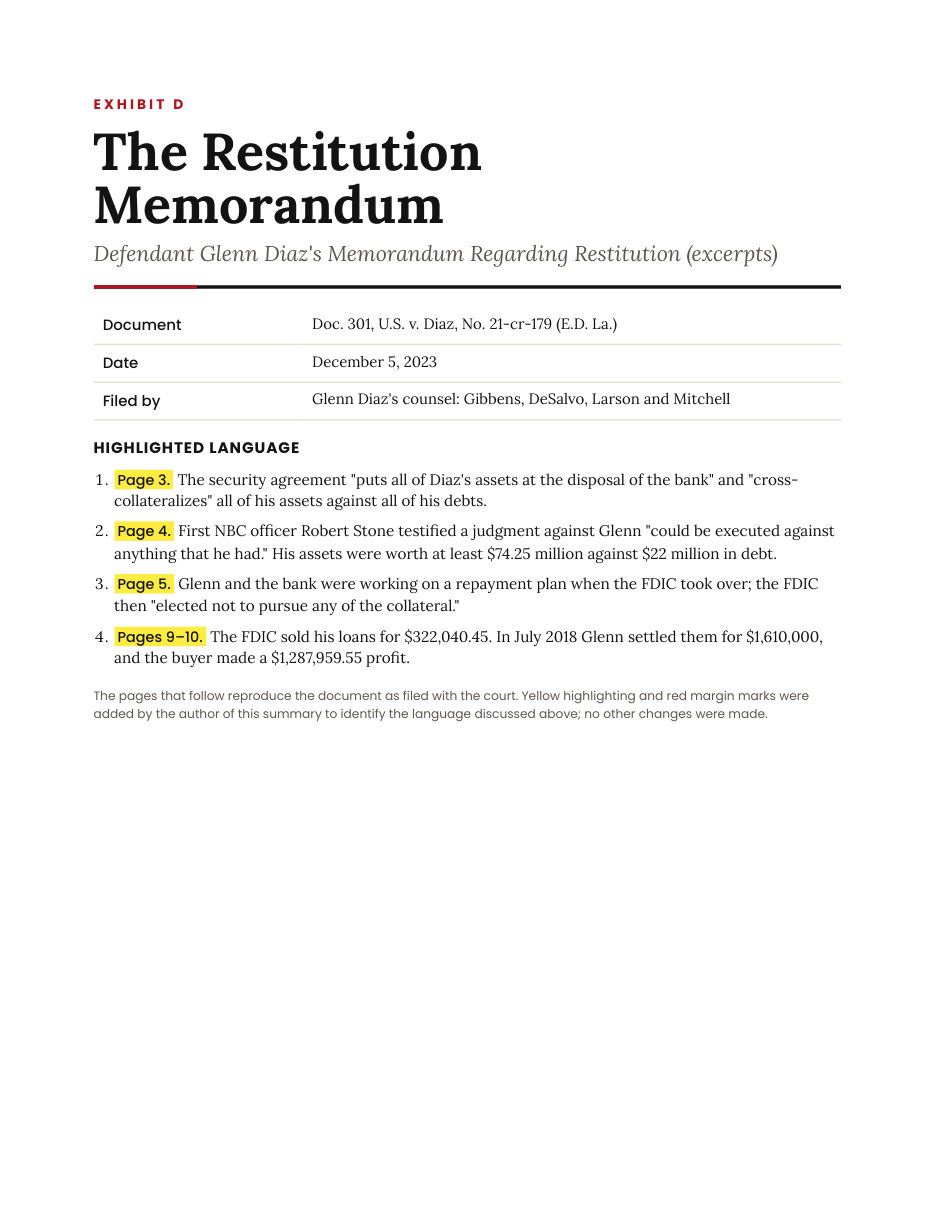
EXHIBIT D
The Restitution Memorandum
Defendant Glenn Diaz's Memorandum Regarding Restitution (excerpts)
Document
Doc. 301, U.S. v. Diaz, No. 21-cr-179 (E.D. La.)
Date
December 5, 2023
Filed by
Glenn Diaz's counsel: Gibbens, DeSalvo, Larson and Mitchell
HIGHLIGHTED LANGUAGE
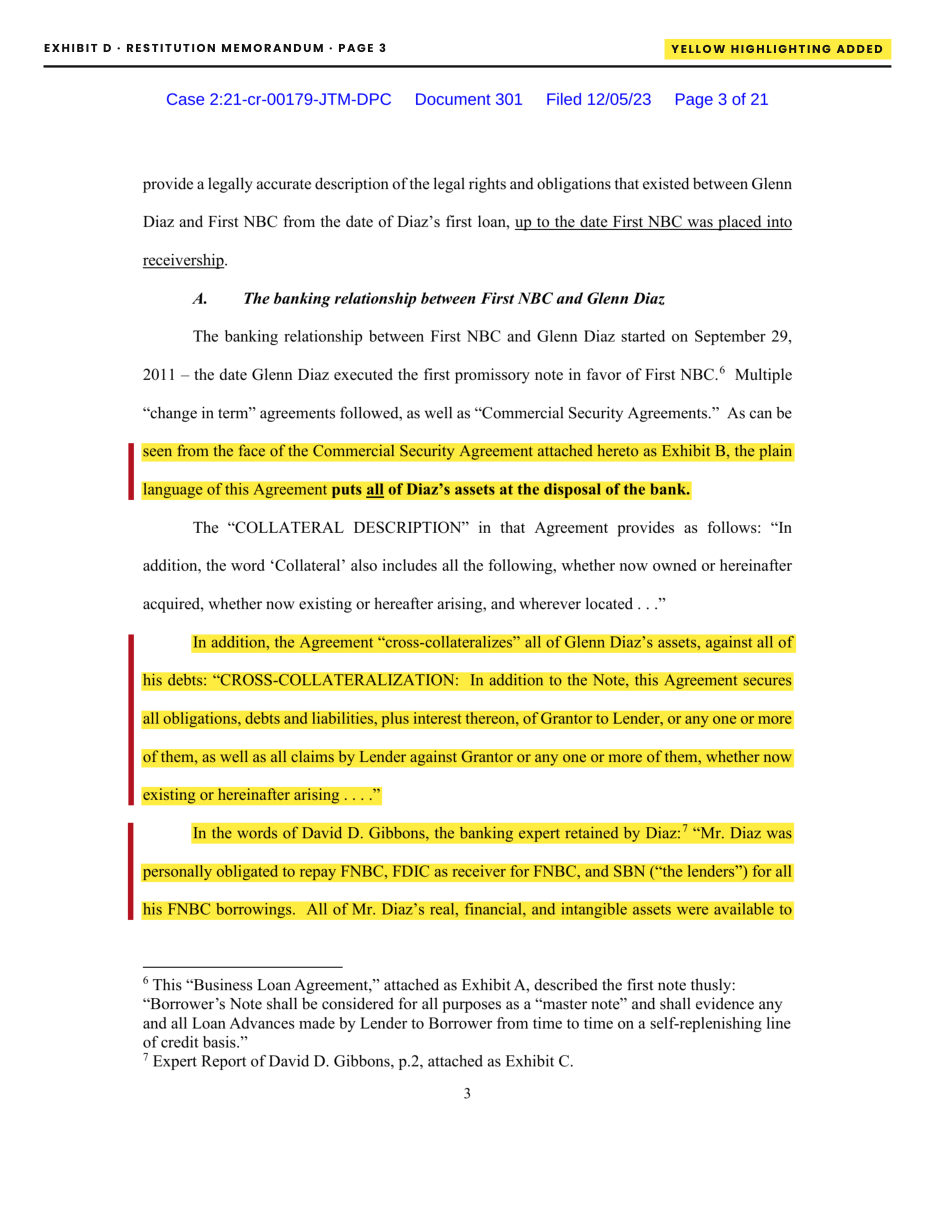
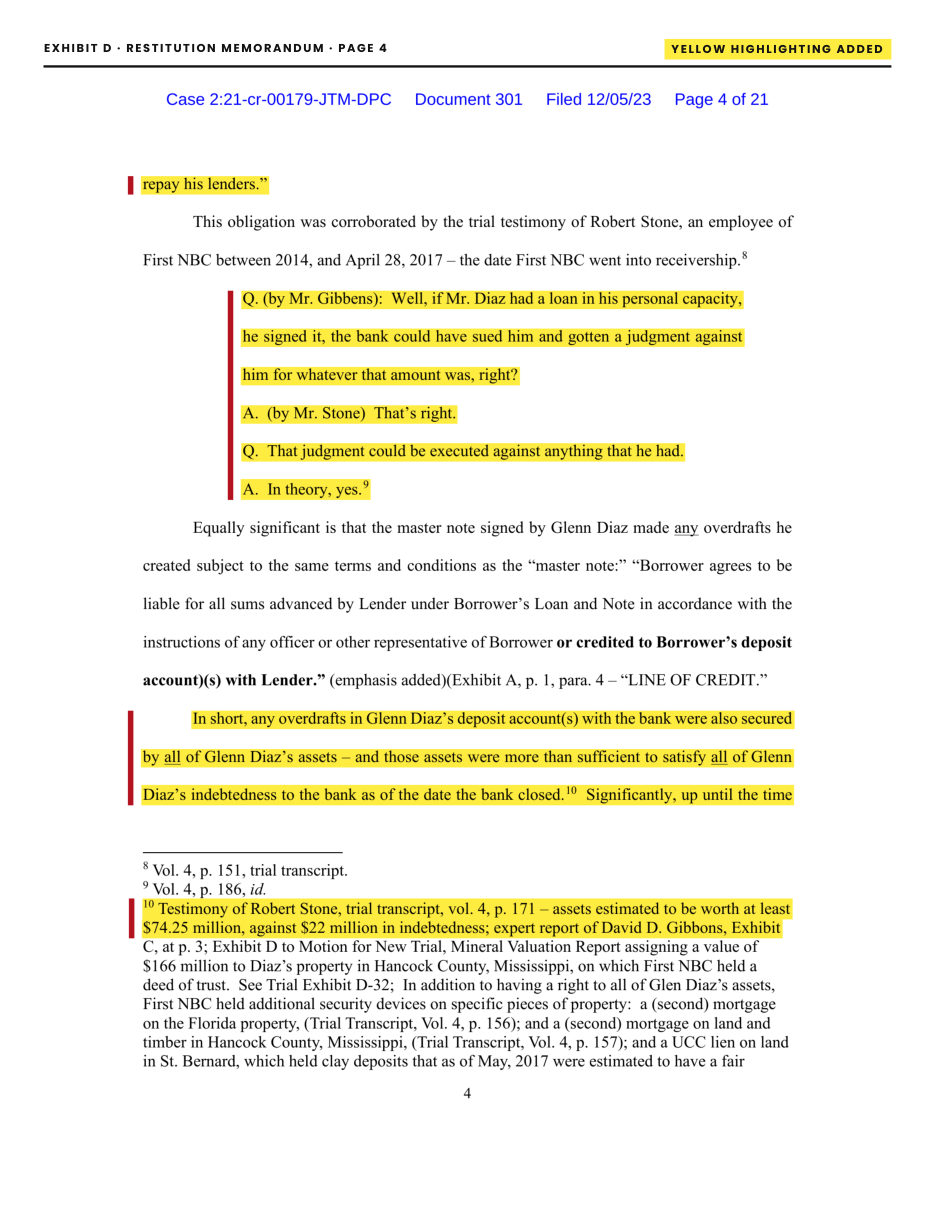
1. Page 3. The security agreement "puts all of Diaz's assets at the disposal of the bank" and "cross- collateralizes" all of his assets against all of his debts. 2. Page 4. First NBC officer Robert Stone testified a judgment against Glenn "could be executed against anything that he had." His assets were worth at least $74.25 million against $22 million in debt. 3. Page 5. Glenn and the bank were working on a repayment plan when the FDIC took over; the FDIC then "elected not to pursue any of the collateral." 4. Pages 9–10. The FDIC sold his loans for $322,040.45. In July 2018 Glenn settled them for $1,610,000, and the buyer made a $1,287,959.55 profit.
The pages that follow reproduce the document as filed with the court. Yellow highlighting and red margin marks were
added by the author of this summary to identify the language discussed above; no other changes were made.
View page 36 as designed (charts and tables)
Page 37
EXHIBIT D · RESTITUTION MEMORANDUM · PAGE 3
YELLOW HIGHLIGHTING ADDED
View page 37 as designed (charts and tables)
Page 38
EXHIBIT D · RESTITUTION MEMORANDUM · PAGE 4
YELLOW HIGHLIGHTING ADDED
View page 38 as designed (charts and tables)
Page 39
EXHIBIT D · RESTITUTION MEMORANDUM · PAGE 5
YELLOW HIGHLIGHTING ADDED
View page 39 as designed (charts and tables)
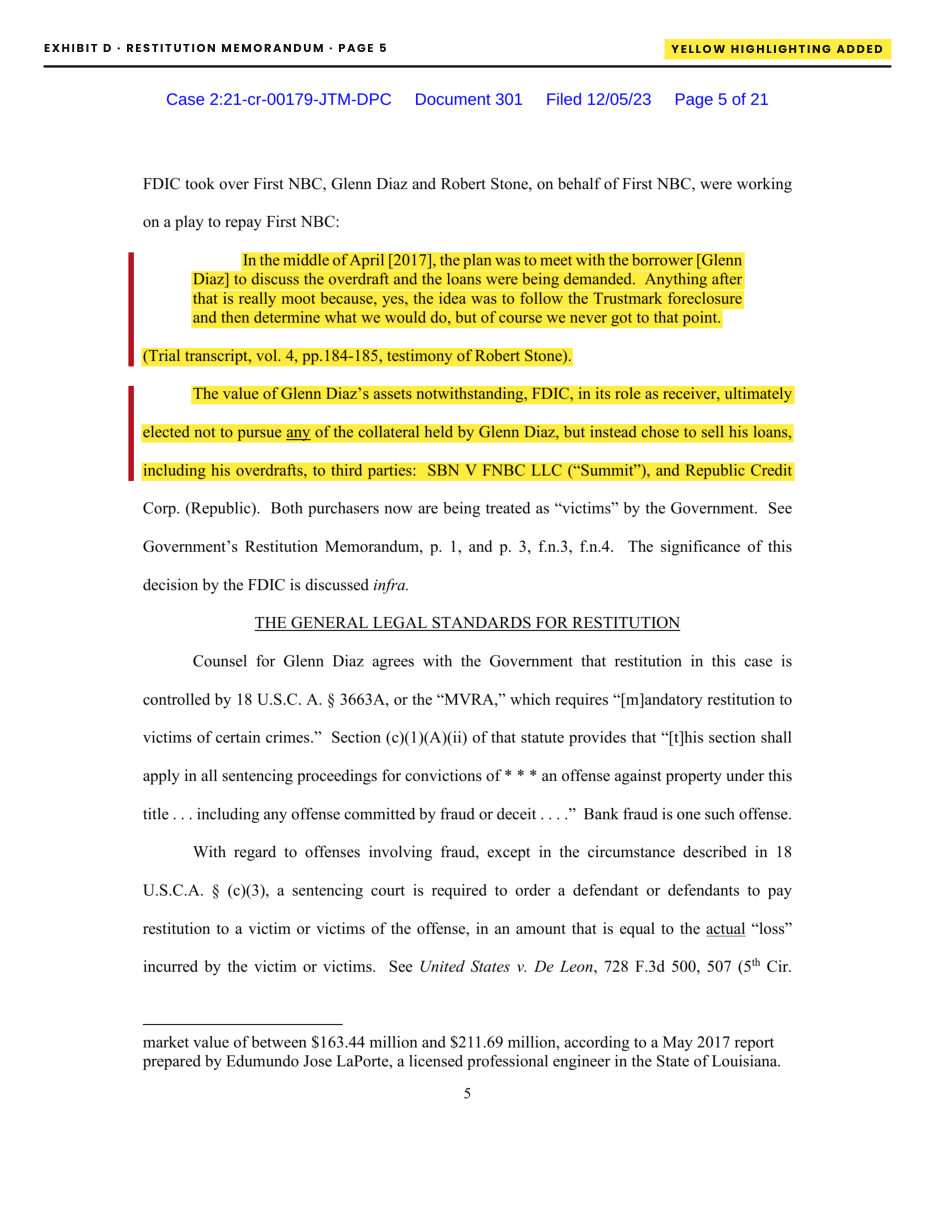
Page 40
EXHIBIT D · RESTITUTION MEMORANDUM · PAGE 9
YELLOW HIGHLIGHTING ADDED
View page 40 as designed (charts and tables)
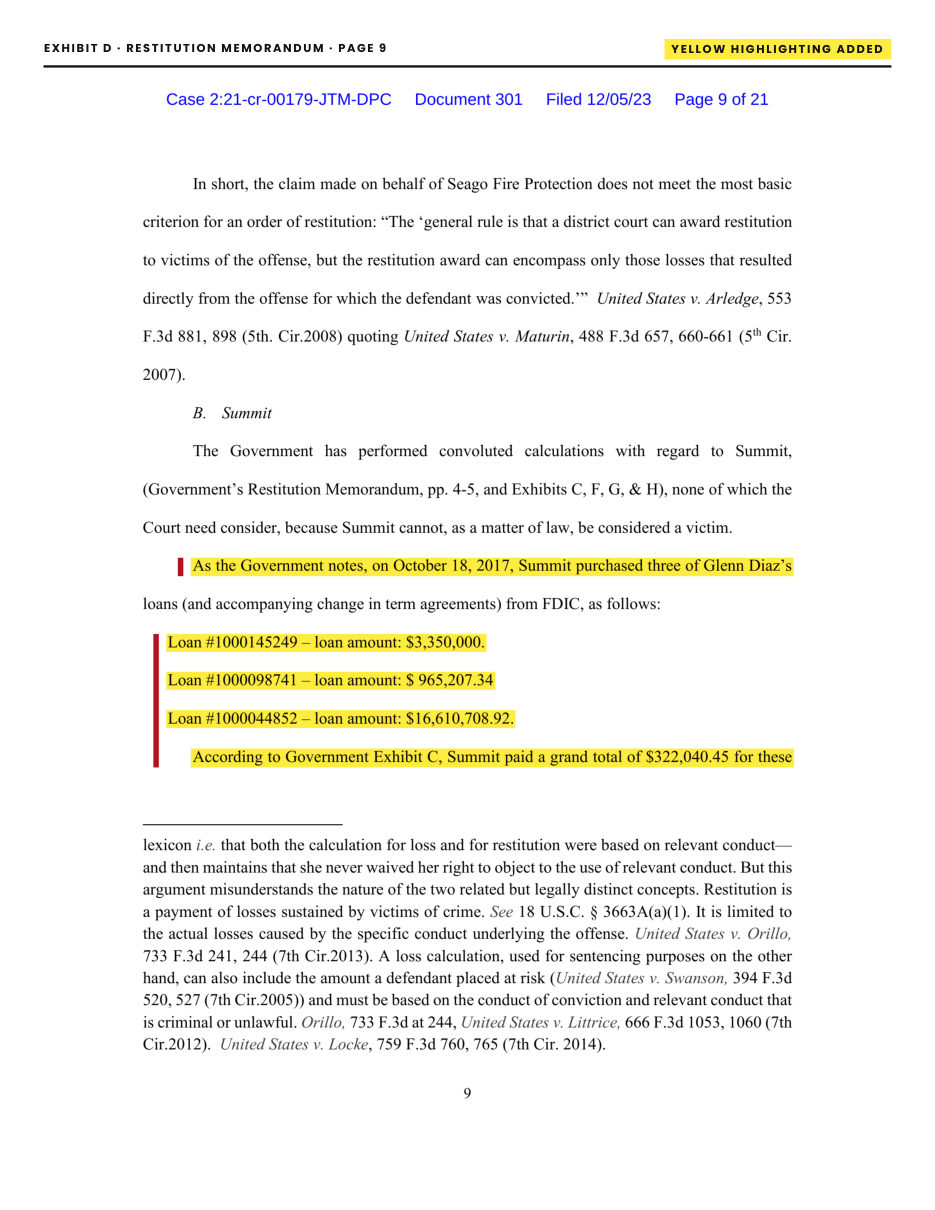
Page 41
EXHIBIT D · RESTITUTION MEMORANDUM · PAGE 10
YELLOW HIGHLIGHTING ADDED
View page 41 as designed (charts and tables)
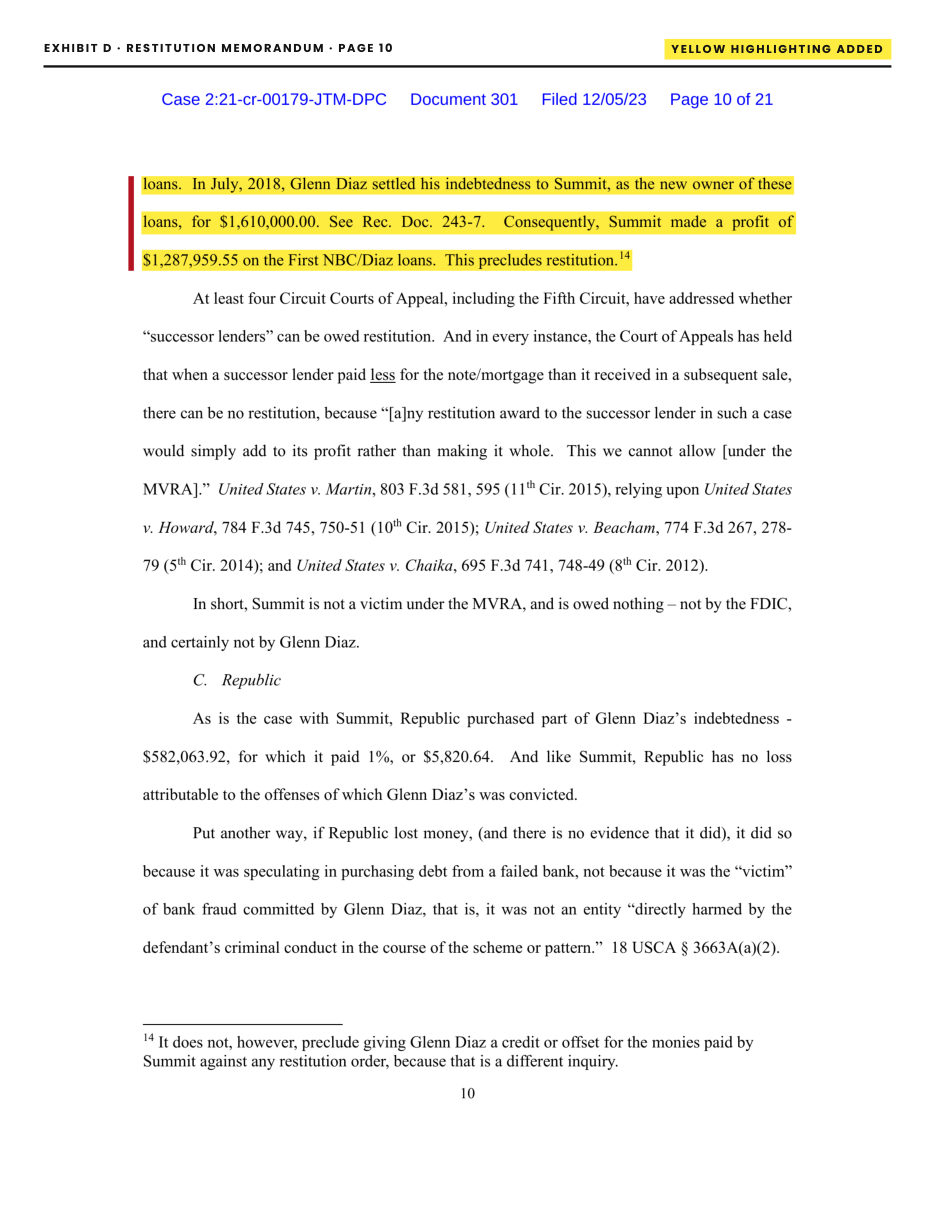
Page 42
EXHIBIT E
The Parish President's Letter
Letter from Louis Pomes, President of St. Bernard Parish, to Governor Jeff Landry
Document
Letter in support of a presidential pardon for Glenn E. Diaz
Date
December 27, 2025
From
Louis Pomes, President, St. Bernard Parish
To
The Honorable Jeff Landry, Governor of the State of Louisiana
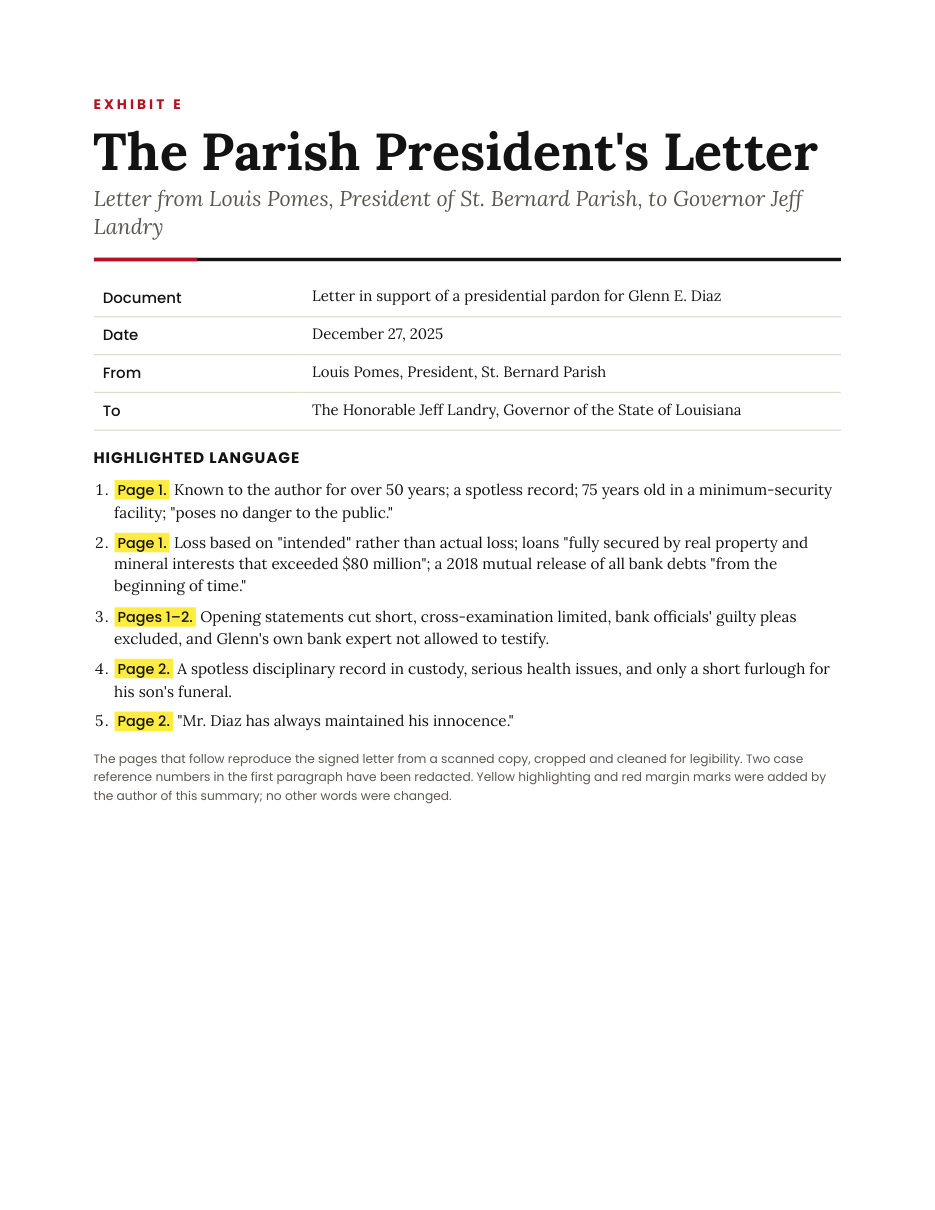
HIGHLIGHTED LANGUAGE
1. Page 1. Known to the author for over 50 years; a spotless record; 75 years old in a minimum-security facility; "poses no danger to the public." 2. Page 1. Loss based on "intended" rather than actual loss; loans "fully secured by real property and mineral interests that exceeded $80 million"; a 2018 mutual release of all bank debts "from the beginning of time." 3. Pages 1–2. Opening statements cut short, cross-examination limited, bank officials' guilty pleas excluded, and Glenn's own bank expert not allowed to testify. 4. Page 2. A spotless disciplinary record in custody, serious health issues, and only a short furlough for his son's funeral. 5. Page 2. "Mr. Diaz has always maintained his innocence."
The pages that follow reproduce the signed letter from a scanned copy, cropped and cleaned for legibility. Two case
reference numbers in the first paragraph have been redacted. Yellow highlighting and red margin marks were added by
the author of this summary; no other words were changed.
View page 42 as designed (charts and tables)
Page 43
EXHIBIT E · PARISH PRESIDENT'S LETTER · PAGE 1
YELLOW HIGHLIGHTING ADDED
View page 43 as designed (charts and tables)
Page 44
EXHIBIT E · PARISH PRESIDENT'S LETTER · PAGE 2
YELLOW HIGHLIGHTING ADDED
View page 44 as designed (charts and tables)
Page 45
250PARDONS.NET
· GLENN E. DIAZ · FINAL WORD
Subject: Weaponization of Federal Prosecution
"TO MAKE AN EXAMPLE"
Prepared by: Shelby Lynn, on behalf of Glenn E. Diaz
Date: November 3, 2026
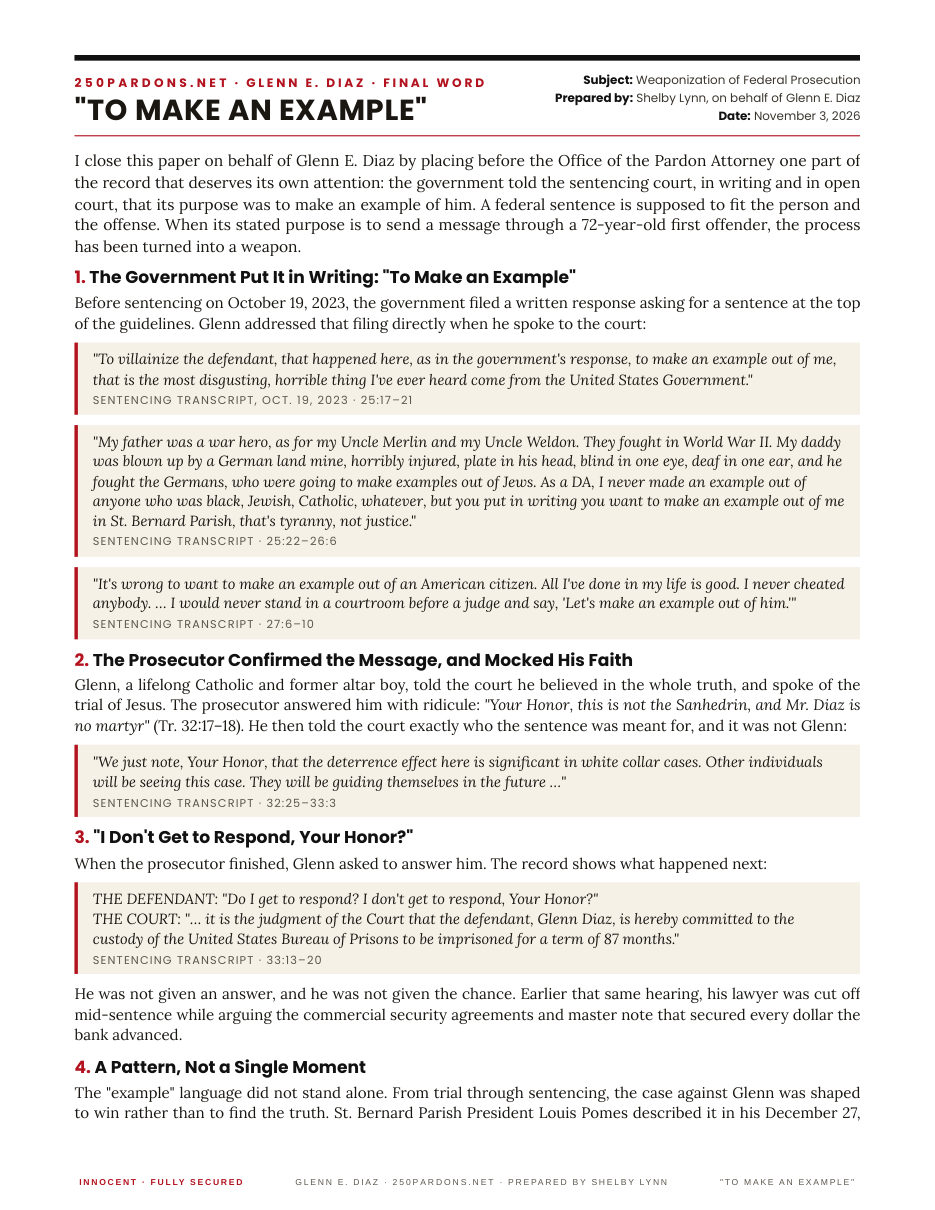
I close this paper on behalf of Glenn E. Diaz by placing before the Office of the Pardon Attorney one part of the record that deserves its own attention: the government told the sentencing court, in writing and in open court, that its purpose was to make an example of him. A federal sentence is supposed to fit the person and the offense. When its stated purpose is to send a message through a 72-year-old first offender, the process has been turned into a weapon.
1. The Government Put It in Writing: "To Make an Example"
Before sentencing on October 19, 2023, the government filed a written response asking for a sentence at the top of the guidelines. Glenn addressed that filing directly when he spoke to the court:
"To villainize the defendant, that happened here, as in the government's response, to make an example out of me,
that is the most disgusting, horrible thing I've ever heard come from the United States Government."
SENTENCING TRANSCRIPT, OCT. 19, 2023 · 25:17–21
"My father was a war hero, as for my Uncle Merlin and my Uncle Weldon. They fought in World War II. My daddy
was blown up by a German land mine, horribly injured, plate in his head, blind in one eye, deaf in one ear, and he
fought the Germans, who were going to make examples out of Jews. As a DA, I never made an example out of
anyone who was black, Jewish, Catholic, whatever, but you put in writing you want to make an example out of me
in St. Bernard Parish, that's tyranny, not justice."
SENTENCING TRANSCRIPT · 25:22–26:6
"It's wrong to want to make an example out of an American citizen. All I've done in my life is good. I never cheated
anybody. … I would never stand in a courtroom before a judge and say, 'Let's make an example out of him.'"
SENTENCING TRANSCRIPT · 27:6–10
2. The Prosecutor Confirmed the Message, and Mocked His Faith
Glenn, a lifelong Catholic and former altar boy, told the court he believed in the whole truth, and spoke of the trial of Jesus. The prosecutor answered him with ridicule: "Your Honor, this is not the Sanhedrin, and Mr. Diaz is no martyr" (Tr. 32:17–18). He then told the court exactly who the sentence was meant for, and it was not Glenn:
"We just note, Your Honor, that the deterrence effect here is significant in white collar cases. Other individuals
will be seeing this case. They will be guiding themselves in the future …"
SENTENCING TRANSCRIPT · 32:25–33:3
3. "I Don't Get to Respond, Your Honor?"
When the prosecutor finished, Glenn asked to answer him. The record shows what happened next:
THE DEFENDANT: "Do I get to respond? I don't get to respond, Your Honor?"
THE COURT: "… it is the judgment of the Court that the defendant, Glenn Diaz, is hereby committed to the
custody of the United States Bureau of Prisons to be imprisoned for a term of 87 months."
SENTENCING TRANSCRIPT · 33:13–20
He was not given an answer, and he was not given the chance. Earlier that same hearing, his lawyer was cut off mid-sentence while arguing the commercial security agreements and master note that secured every dollar the bank advanced.
4. A Pattern, Not a Single Moment
The "example" language did not stand alone. From trial through sentencing, the case against Glenn was shaped to win rather than to find the truth. St. Bernard Parish President Louis Pomes described it in his December 27,
View page 45 as designed (charts and tables)
Page 46
2025 letter to Governor Jeff Landry: Glenn's lawyers "were stopped from completing opening statements," crucial witnesses "were not allowed to be fully cross examined," the defense "was prohibited from mentioning the guilty pleas and conviction of bank officials," and "Mr. Diaz's own bank expert, after being accepted by the court, was not allowed to testify."
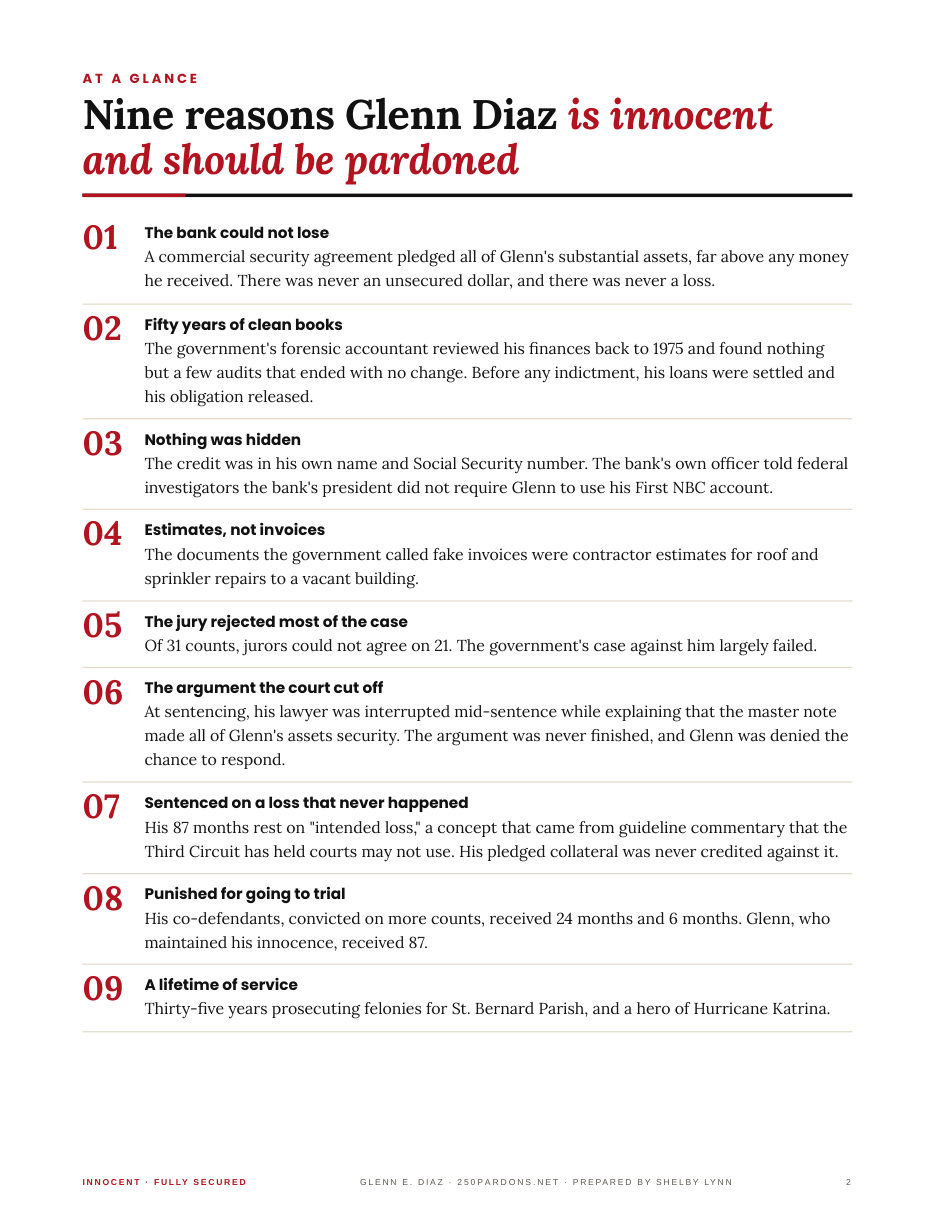
No loss. In July 2018, before any indictment, Glenn
Fully secured. His commercial security agreements
settled his loans for $1.61 million with the company that
pledged everything he owned. Not one cent of any bank
bought them from the FDIC, and was released from all of
advance to Glenn was unsecured.
his bank debts.
Not the cause. It was stipulated at trial that Glenn had
Key witness barred. Ashton Ryan, the banker who
nothing to do with the failure of First NBC Bank.
actually managed Glenn's loan, was never allowed to be
called.
A paper "loss." His 87 months rest on "intended loss"
The trial penalty. Co-defendants convicted on more
drawn from guideline commentary, with every dollar of
counts received 24 months and 6 months. Glenn, who
his collateral left out.
exercised his right to trial, received 87.
Together they show a prosecution aimed at a person, a former prosecutor whose public career made him a useful "message," rather than at a crime that cost anyone a dollar.
5. Why This Matters Now
On January 20, 2025, the President signed Executive Order 14147, Ending the Weaponization of the Federal Government, directing a review of federal law-enforcement actions that were used to punish rather than to serve justice. Glenn's case belongs in that review. The government did not hide its purpose: it wrote it down, repeated it in open court, and ridiculed his faith. The law asks for a sentence "sufficient, but not greater than necessary" for the person standing before the court (18 U.S.C. § 3553(a)). It does not permit a man's remaining years to be spent as a public warning. Glenn is now 75. He served 35 years as a prosecutor in St. Bernard Parish without ever asking a court to make an example of anyone. He has no prior record, and he is the father figure to a 12-year-old grandson who has already lost his father. His father and uncles fought a war against making examples of people. Glenn spent his career refusing to do it to anyone. He asks only for the same fairness he gave every defendant who stood before him.
Request. For the reasons in this paper, I respectfully ask that the President grant Glenn E. Diaz a full pardon or, at minimum, commute his sentence to time served, so that a sentence imposed to make an example of him does not cost him the rest of his life with his family.
Respectfully submitted,
Shelby Lynn
On behalf of Glenn E. Diaz
View page 46 as designed (charts and tables)